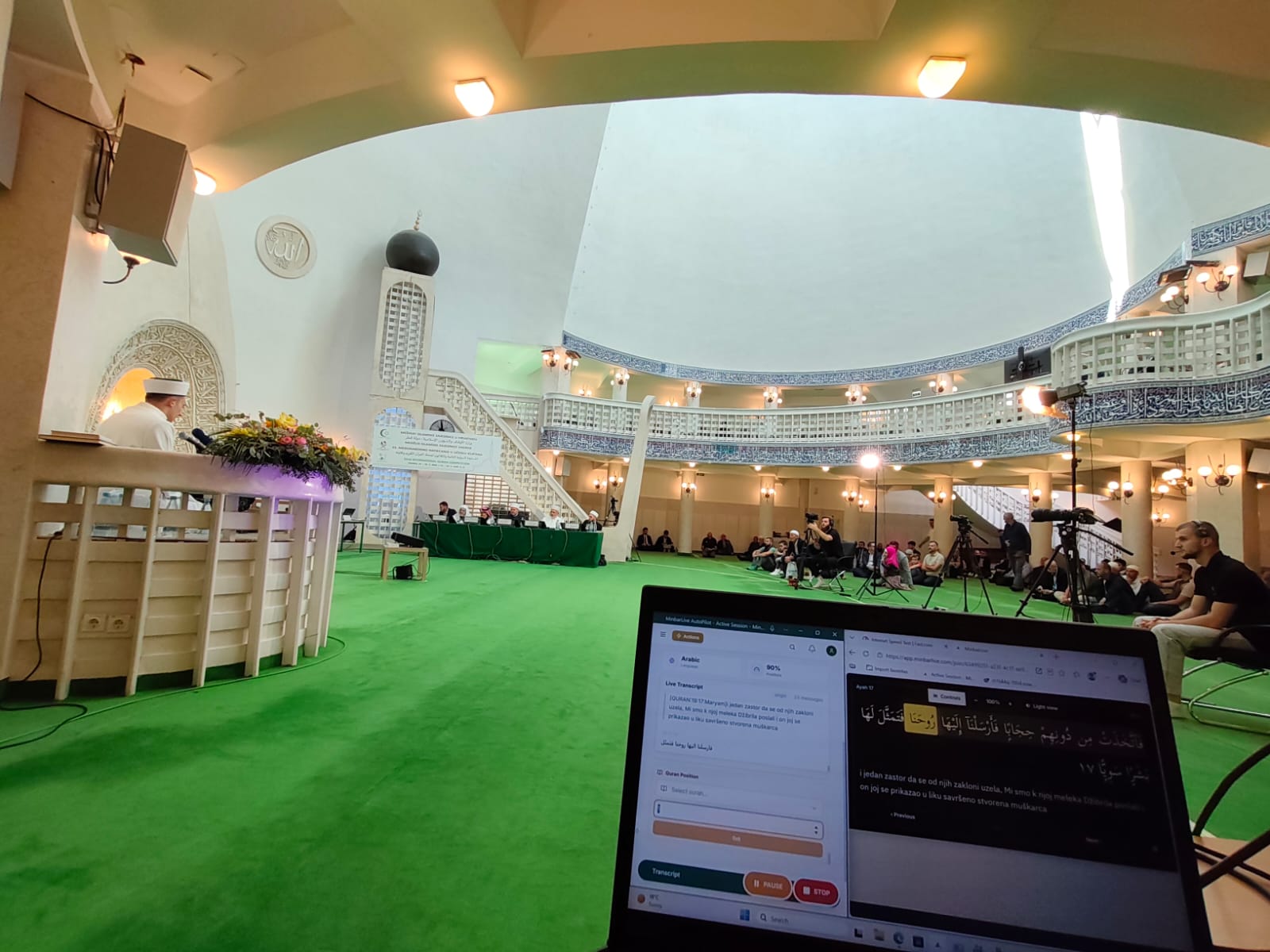
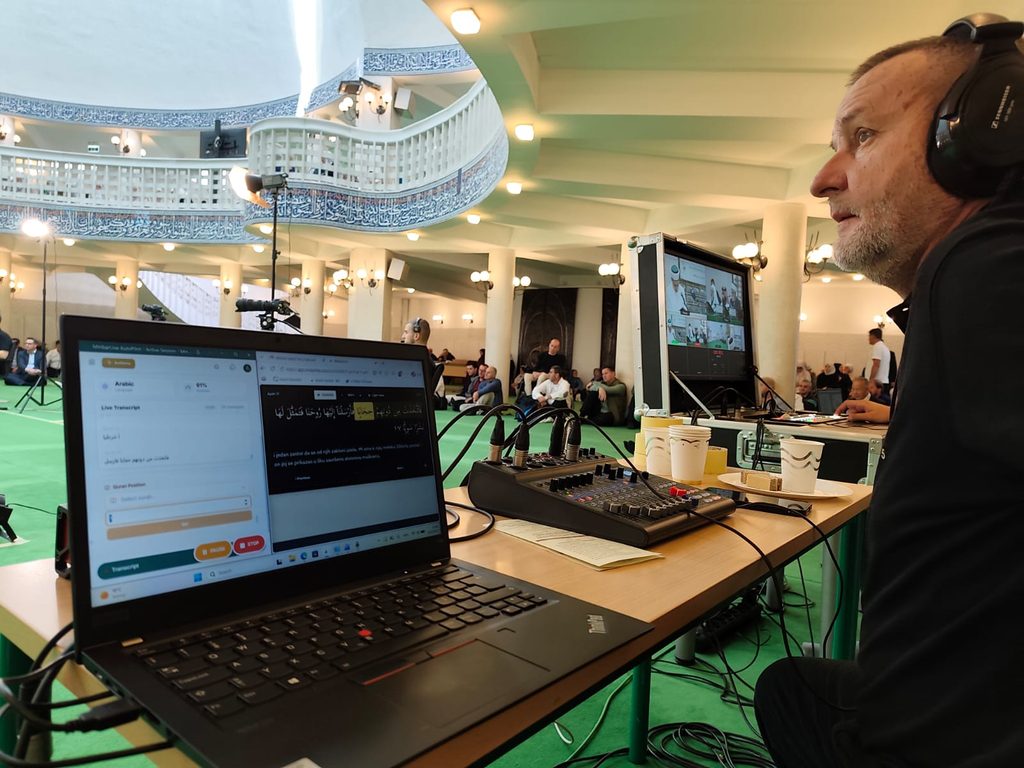
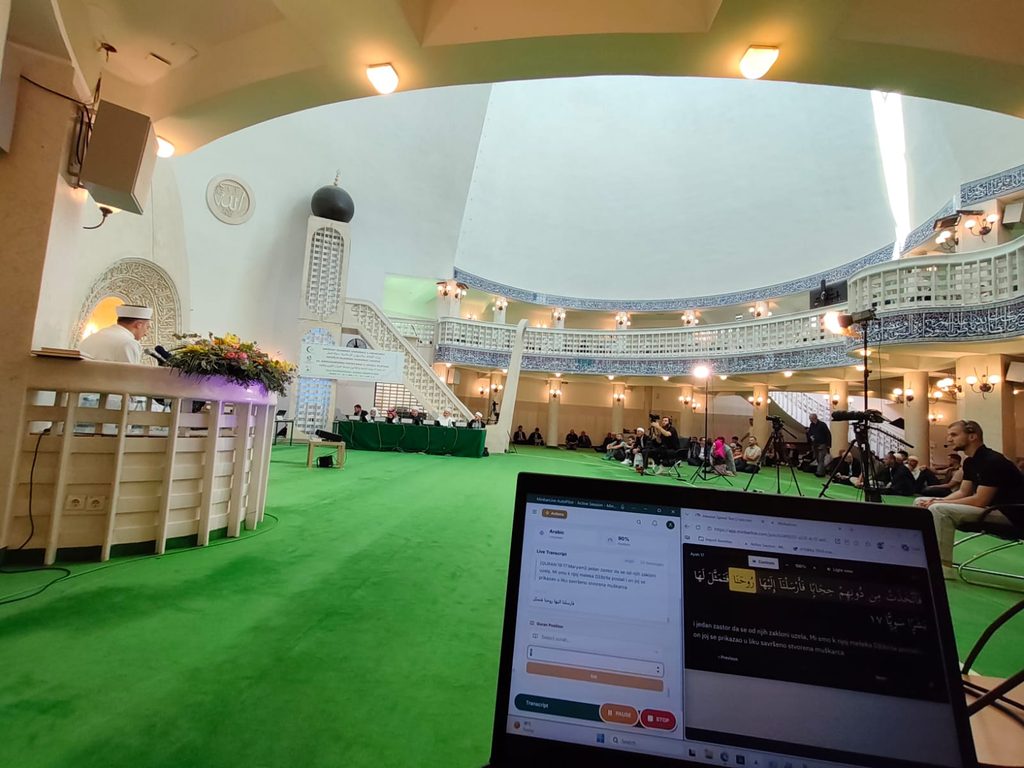
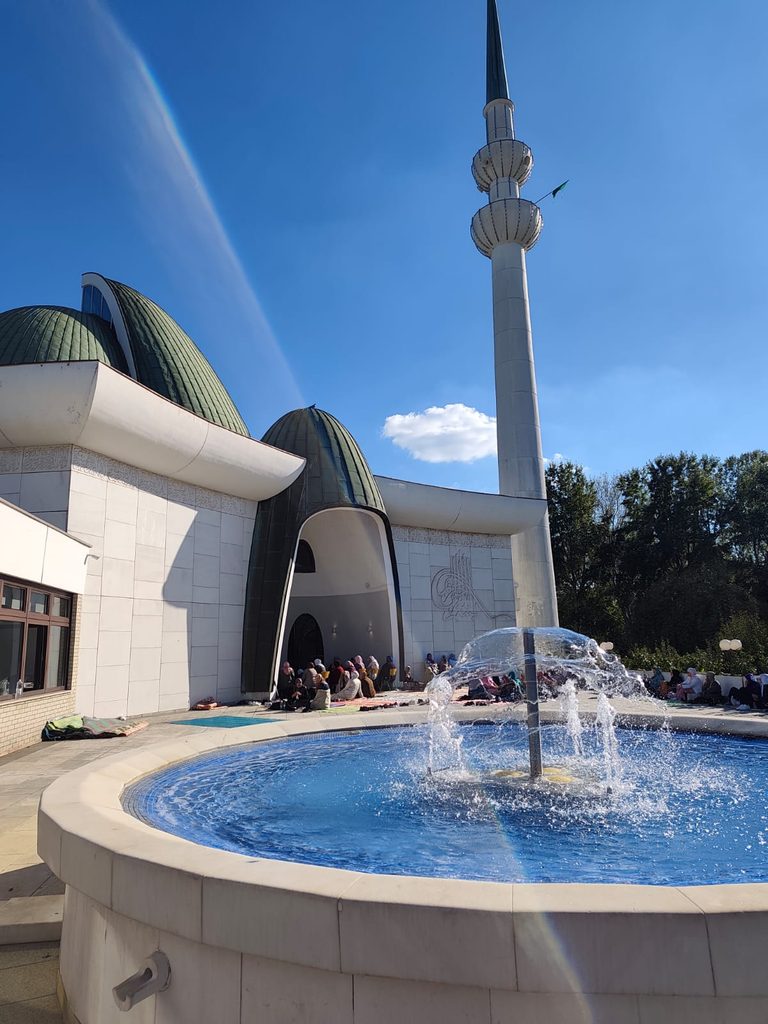
In recent days, the 32nd International Qur’an Recitation Competition was held at the Islamic Centre Zagreb, also marking the 39th anniversary of the ceremonial opening of the Zagreb Mosque.
This is a traditional international event that connects Zagreb every year with Qur’an reciters from different parts of the world. This year, around 50 contestants took part, in the categories of tilawah, 15 juz’ and hifz.
For MinbarLive, this competition was a special experience. We had the opportunity to take part in its program and technical delivery through the use of our system for real-time Qur’an recitation recognition.
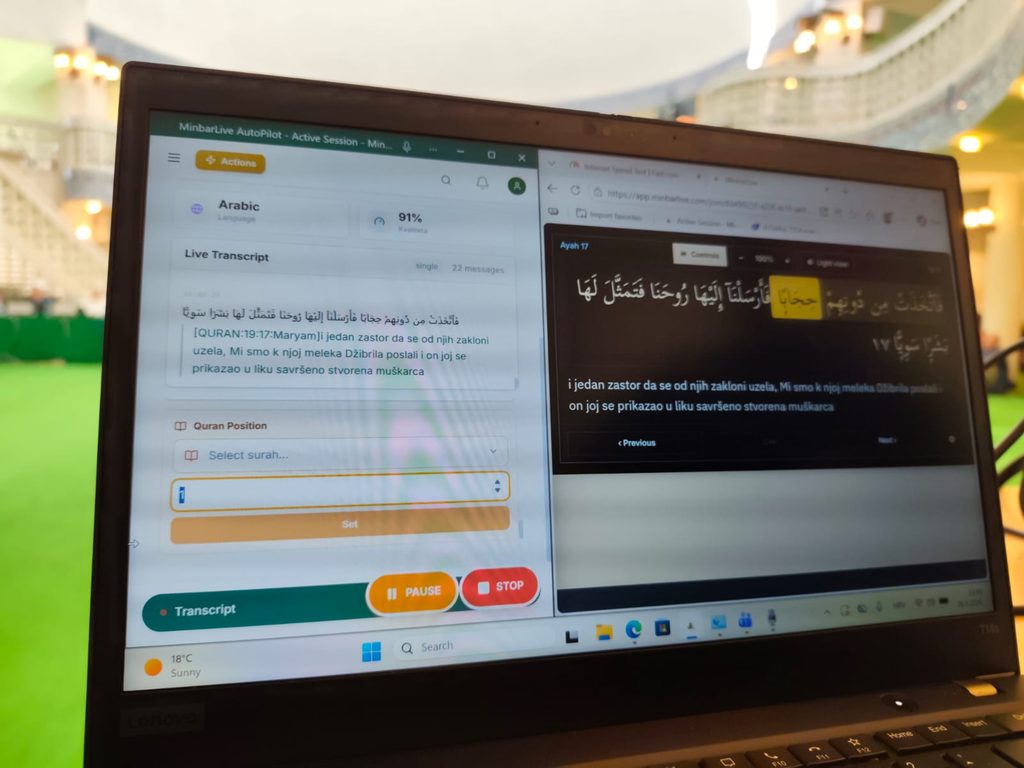
The Qur’anic text and translation followed the reciter
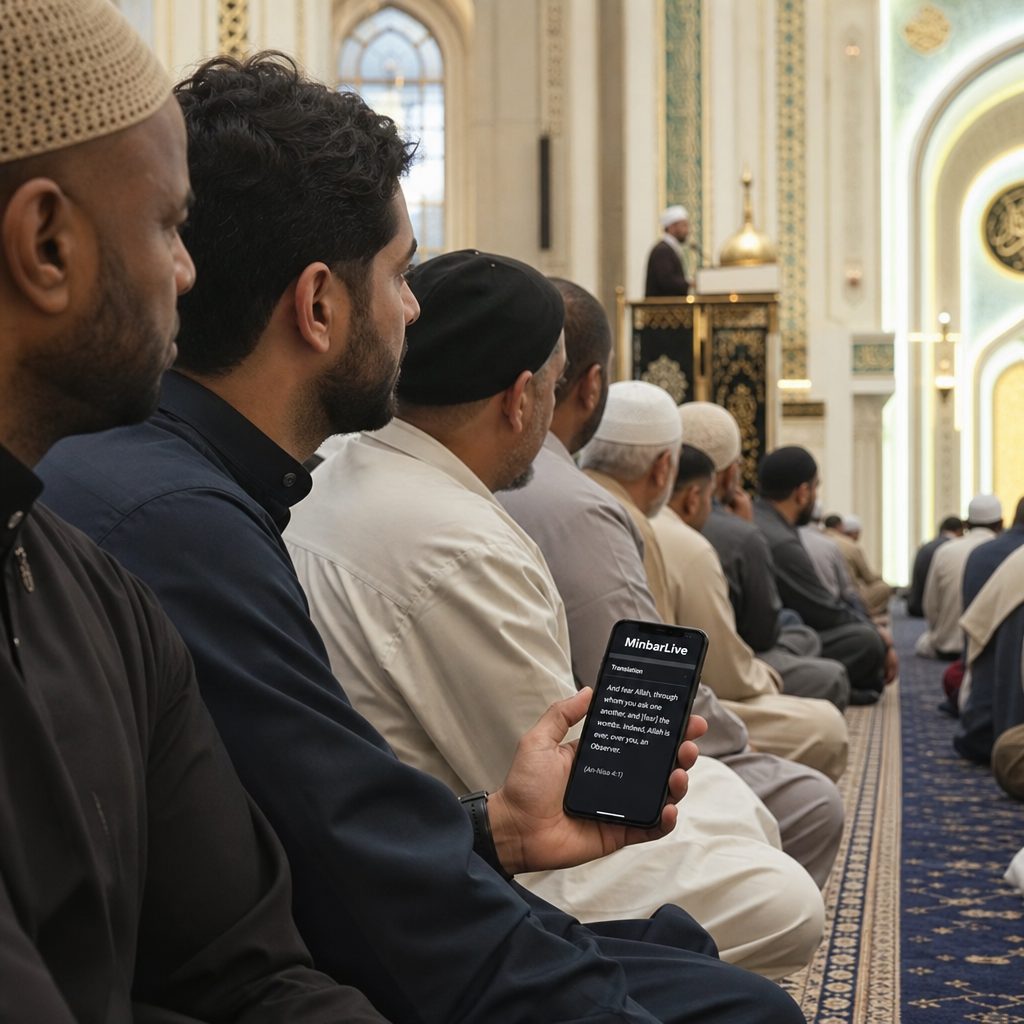
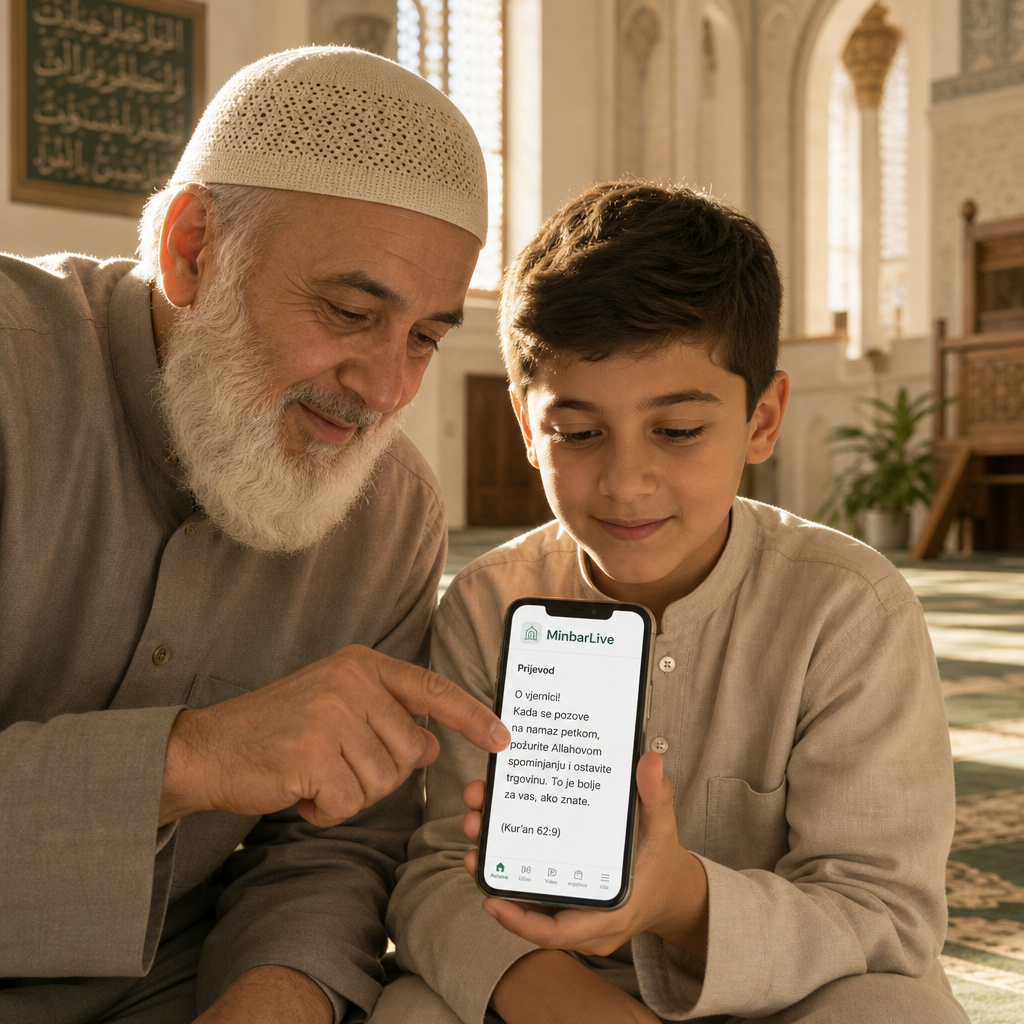
During the competition, MinbarLive tracked the contestants’ recitation, automatically recognized the part of the Qur’an currently being recited, and displayed the corresponding Arabic verse text and its translation to visitors.
It was especially important to us that the technology did not distract from the recitation itself. The idea is exactly the opposite: to help the listener follow more easily what they are already hearing.
Each visitor could independently choose the language in which they wanted to follow the meaning of the Qur’an, from more than 40 languages for which official translations are available in the system.
That means the same performance, at the same moment, can be accessible to people from different language backgrounds — without the organizer needing to choose a single common translation language in advance.
Recognition in just a few seconds
One of the most demanding parts of such a system is speed.
With regular speech, the system can follow a continuous sequence of words. With Qur’an recitation, it is additionally necessary to understand where the reciter currently is within the Qur’anic text, identify the verse, and maintain synchronization even when reciters have different pacing, recitation styles, and performance approaches.
During the competition, recognition happened within just a few seconds. The system enabled near real-time word-level tracking, while tracking and synchronization at the verse level proved very reliable in practical use.
On the screen, it was therefore possible to follow the Arabic text currently being recited, the position within the verse, and the selected translation.
When technology serves understanding the Qur’an
This kind of Qur’an competition tracking is still very rare.
Automatic recognition of Qur’an recitation itself is a demanding technical problem. When you add near-instant verse identification, text tracking, and simultaneous availability of translations in dozens of languages, you get something that until recently was hard to imagine in a real-world setting and in front of an audience.
That is why we see this experience primarily as one of the pioneering examples of how modern technology can be used to make access to and understanding of the Qur’an easier.
And we are especially glad that such an example was realized right here in Zagreb.
For almost four decades, the Islamic Centre Zagreb has been a venue for numerous international meetings, programs, and initiatives. This year’s competition showed that this space can also be a place where traditional content and new technologies meet in a natural and meaningful way.
An experience that will support further development
For MinbarLive, working on the competition was much more than a technical demonstration.
Working in real conditions, with a large number of reciters from different countries, with different qira’at and performance characteristics, and a multi-hour program, gave us valuable experience for the further development of Quran Mode and the way users can follow the Qur’an live.
The goal remains simple: the technology should be almost unnoticeable, while enabling the listener to connect as easily as possible with the text being recited at that moment.
We are grateful to the organizers of the 32nd International Qur’an Recitation Competition and the Islamic Centre Zagreb for the opportunity for MinbarLive to be part of this year’s program.
For us, it was especially meaningful to see the technology we are building used exactly where it finds its true purpose — while the Qur’an is being recited live, and people can simultaneously follow its text and understand its meaning in their own language.
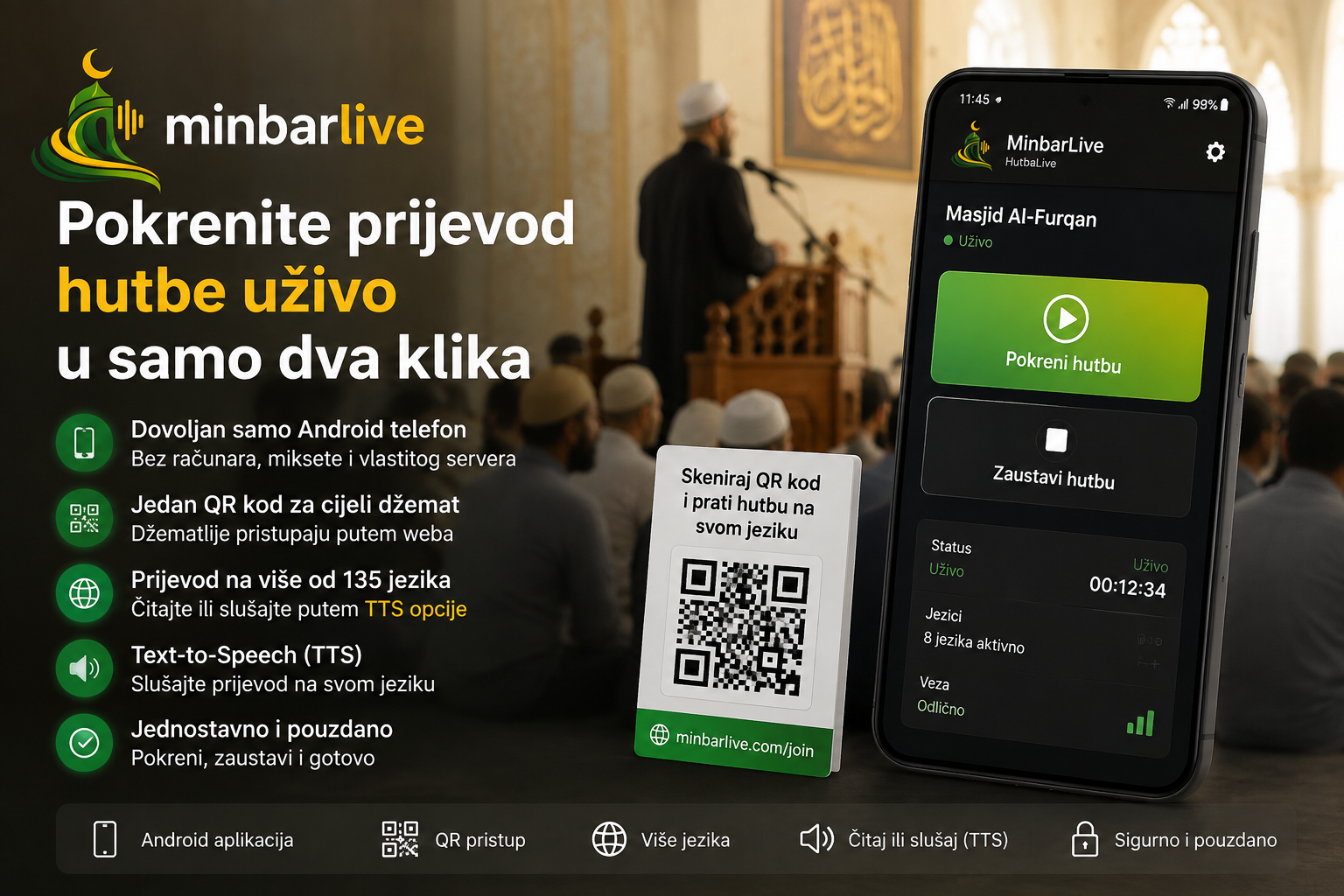
To start live khutbah transcription and translation, you no longer need a computer, mixers, complicated microphones, or your own server. An Android phone, the MinbarLive app, and a single QR code are enough.
One of MinbarLive’s main goals from the very beginning has been to make it possible for every person in the mosque to understand the khutbah, regardless of the language they speak.
However, technology for live speech transmission and translation can often seem complicated. Many people immediately think of computers, cables, mixers, additional microphones, servers, and someone who has to know how to connect and maintain everything.
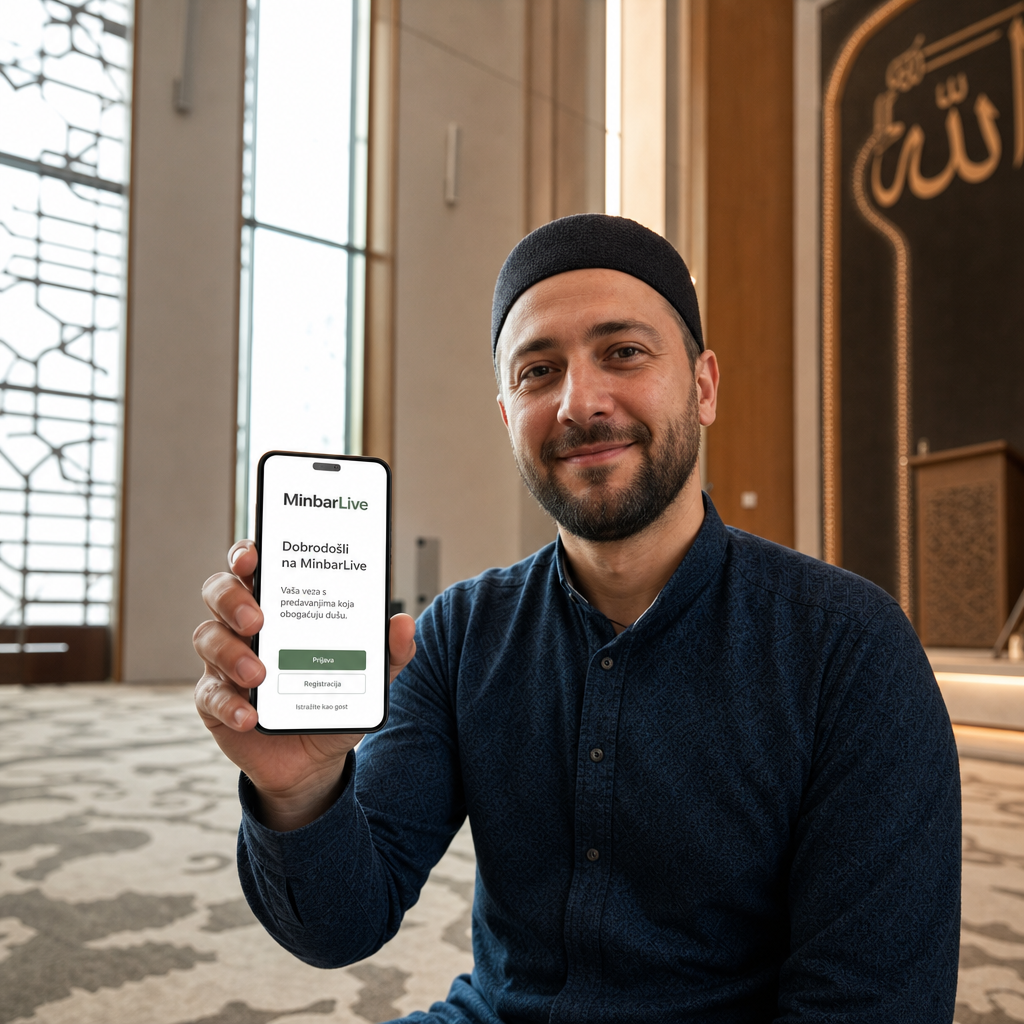
That’s why we built the MinbarLive Android app, specifically intended for imams, mosques, and Islamic organizations.
Now the whole process is much simpler:
Open the app. Start the khutbah.
When the khutbah ends, you press the stop button.
That’s it.
Live khutbah in two clicks
The MinbarLive Android app is built so that it can be used even by people without special technical knowledge.
There’s no need to reconfigure a large number of options every Friday. There’s no need to connect a computer to the PA system or run complicated software.
An authorized person only needs to:
open the MinbarLive app
press the button to start the khutbah
The app uses the Android phone’s microphone and enables speech transmission to the MinbarLive platform.
While the imam speaks, MinbarLive converts speech to text and enables its translation into the languages used by members of the congregation.
After the khutbah ends, it’s enough to press the stop button.
No computer, mixer, or your own server
For basic use of the MinbarLive Android app, you do not need:
a dedicated computer in the mosque
your own local server
a mixer
a professional sound card
complicated recording software
a large number of cables
a dedicated technical person to operate the system
An Android phone with internet access is enough.
Of course, mosques that already have a professional audio system can still use it. However, such equipment is no longer necessary to start live khutbah transcription and translation.
This makes MinbarLive accessible to smaller congregations, masjids, temporary spaces, student communities, Islamic associations, and lecture organizers who do not have permanent technical equipment.
One QR code for the whole congregation
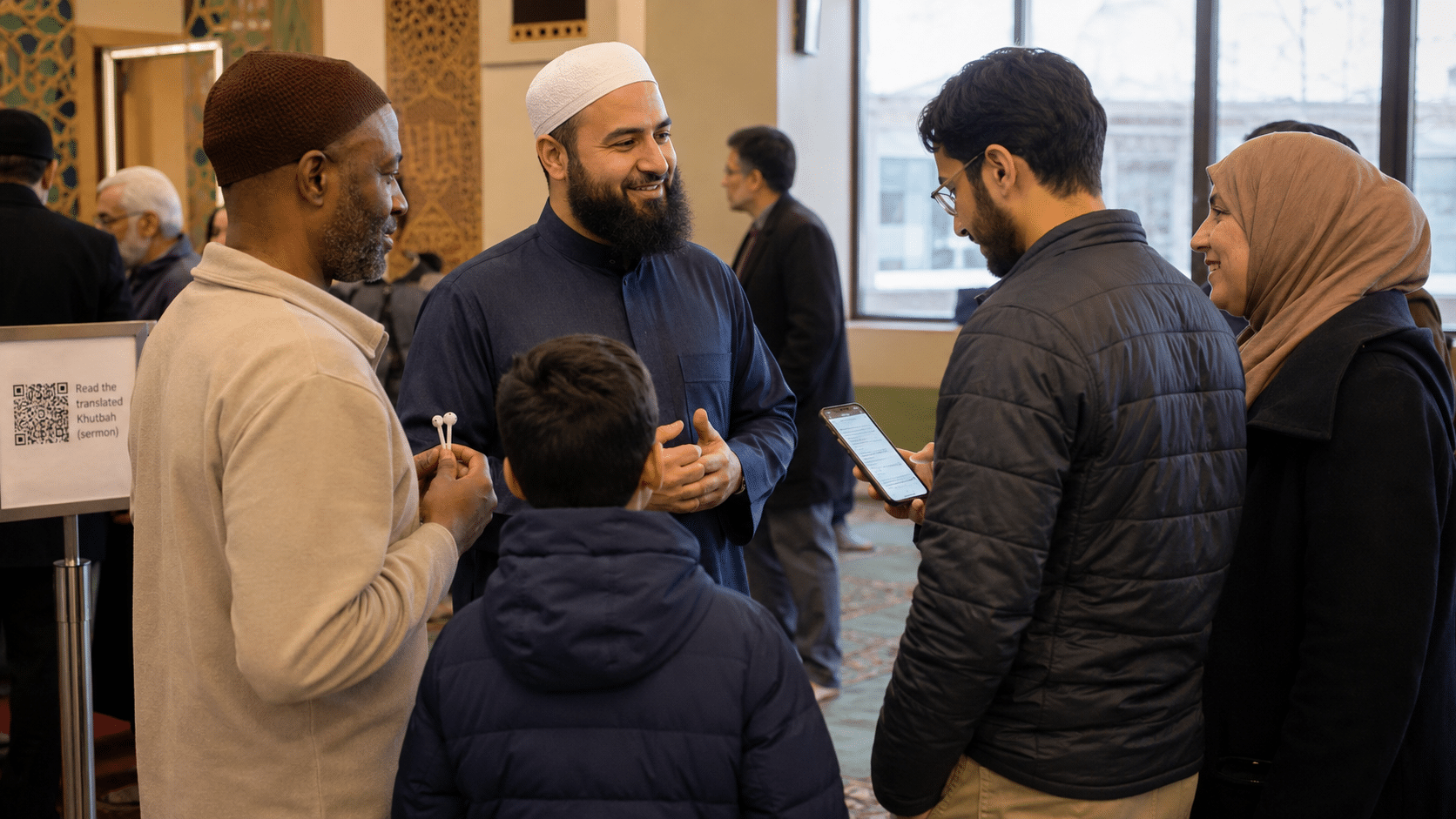
After the khutbah is started, congregation members can access it by scanning a QR code.
The QR code can be placed:
at the mosque entrance
on the notice board
on a wall poster
on a screen or projector
on tables and other accessible places
on the mosque website and social media
A congregant opens the phone camera, scans the QR code, and immediately accesses the page for following the khutbah.
For listeners, there are no complicated logins, account creation, or setup.
The Android app is used by the imam or an authorized person who starts the khutbah. Other users can follow the khutbah via a web browser on their phone.
Each person chooses the language they understand
After scanning the QR code, the user can choose the language in which they want to follow the khutbah.
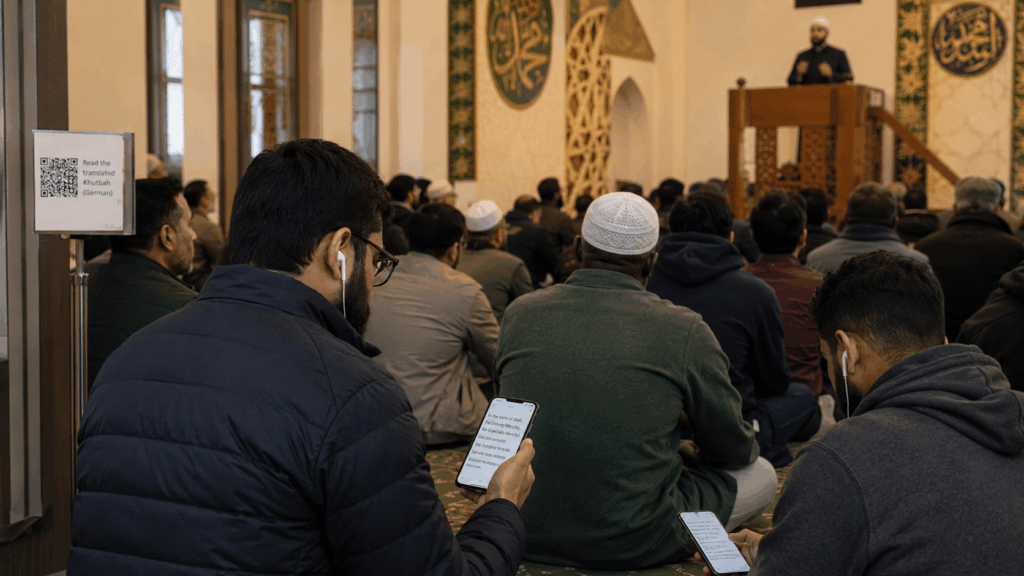
While the imam speaks, the transcript and translation are displayed on the phone in real time. This way, the same khutbah can simultaneously be available to people who speak different languages.
For example, the imam can deliver the khutbah in Bosnian, while one person follows it in German, another in English, a third in French, and a fourth in Turkish.
There is no need for the imam to repeat the same message in several languages. There is also no need for the mosque to provide a dedicated translator for each language.
The imam continues speaking as before, while MinbarLive enables each user to follow the message in the language they understand best.
The translation can be read or listened to
MinbarLive doesn’t only offer a text display of the khutbah.
A Text-to-Speech option, or TTS, is also available, which turns the translated text into speech.
This means a congregant can:
scan the QR code
choose their language
enable audio translation
listen to the translation using headphones
This way, the user can choose whether they want to read the khutbah translation on the screen or listen to it.
TTS is especially useful for people who find it difficult to watch the imam and read text on a phone at the same time. It can also help older people, visually impaired users, and anyone who prefers listening rather than reading a translation.
For listening to the translation, the use of headphones is recommended so as not to disturb the imam and other congregation members.
In this way, each user gets a personal audio translation directly on their own phone—without additional receivers, special devices, or a separate simultaneous interpretation system.
The imam doesn’t have to change the way he delivers the khutbah
MinbarLive is built so that technology is not the center of attention.
The imam doesn’t have to learn to use complicated equipment. He doesn’t have to interrupt his speech for a translator or deliver the khutbah in several languages.
He can speak naturally and deliver the khutbah in the same way as before.
The technical part happens in the background:
the app transmits the speech
MinbarLive creates the transcript
the content is translated
congregants choose their language
the translation is displayed as text
users enable TTS when needed and listen to the translation
The goal is for the technology to be as simple and almost unnoticeable as possible, while making the khutbah message available to as many people as possible.
Especially useful for multilingual congregations
An increasing number of mosques bring together people of different backgrounds and different native languages.
In the same mosque, there may be:
local Muslims
students and workers from other countries
tourists and travelers
people who have recently accepted Islam
children who understand their parents’ language less well
members of mixed families
people who are only learning the language of the country they live in
deaf, hard-of-hearing, and visually impaired people
A person may regularly attend Jumu’ah, yet understand only a small part of the khutbah. They may hear Qur’anic verses and feel the atmosphere of Jumu’ah, but not understand the main message the imam wants to convey.
MinbarLive helps remove that language barrier.
One imam speaks, and each congregation member can follow the khutbah in the language they understand.
Useful beyond Jumu’ah prayer
Although the app is primarily built for khutbahs, the same simple workflow can be used for other content as well.
MinbarLive can help during:
Islamic lectures
seminars and conferences
Ramadan programs
Tarawih prayer
mukabela
education for new Muslims
youth programs
interfaith meetings
international events
guest lectures by speakers from other countries
The organizer needs to start the stream, and visitors can follow the content in their language by scanning the QR code.
Fewer technical barriers, more accessible khutbahs
The most important advantage of the new Android app is not just that MinbarLive can be started from a phone.
What matters most is that we removed one of the biggest obstacles to using live translation: complicated technical setup.
Now it’s enough:
One Android phone. One internet connection. One QR code. Two clicks.
Congregants can then read or listen to the khutbah in the language they understand.
No server of your own. No dedicated computer. No mixer. No lengthy setup.
Technology becomes simpler, and the khutbah message becomes more accessible.
Download the MinbarLive Android app
The MinbarLive Android app is available on the Google Play Store:
Throughout history, jamaats have always adapted to the times they live in. Once, the main way of communicating was a notice on the mosque door, a verbal announcement after Jumu’ah, or a message passed from person to person. And that had its own strength.
But today’s jamaats live in a completely different environment.
People work different shifts. Young people increasingly look for information on their phones. Some community members do not live near the mosque. Many were born in the diaspora and understand another language better than their parents’ language. In larger cities there are more and more foreign workers, students, travelers, and new Muslims who may want to be part of the community, but do not understand the language in which the khutbah, lecture, or announcement is delivered.
That is why an important question is placed before Islamic organizations:
How do you stay close to people when lifestyles, languages, and communication habits are changing quickly?
The answer is not for the jamaat to lose its soul and become a “digital company.” Quite the opposite. The goal of digital tools is to help the jamaat make what it already does—valuable, beneficial, and noble—available to more people.
That is the essence of the idea of a digital jamaat.
What does a digital jamaat mean?
A digital jamaat is not a jamaat that replaces the mosque with the internet.
The mosque remains the heart of the community. Congregational prayer, the khutbah, lessons, gatherings, maktab, humanitarian work, and direct human contact cannot be replaced by a screen.
But a digital jamaat uses technology to expand access to what is already happening in the physical space.
This means that a khutbah does not end the moment the imam steps down from the minbar. It can remain available as text, audio, video, a translation, a quote, a short clip, or educational content that someone will find days, months, or years later.
This means that a lecture does not have to be heard only by the person who was physically present. It can be watched later by someone who works on Fridays, someone who lives far away, someone who is ill, someone who does not understand the original language, or someone who is only getting to know Islam.
This means the jamaat communicates not only with those who already attend regularly, but also with those on the edge of the community—those who want to connect, but don’t know how.
Why is digital communication important for Islamic organizations today?
Most Islamic organizations already have some form of digital presence—maybe a Facebook page, a WhatsApp group, a YouTube channel, or a basic website.
But it often happens that this communication is unorganized. Announcements are scattered across different channels. Video lectures have no subtitles. Khutbahs are not archived. Foreigners and younger generations cannot understand the content. Websites are not updated regularly. Valuable material remains “buried” in old posts.
The problem is not that organizations don’t have content.
On the contrary, many jamaats produce very valuable content every week: khutbahs, lessons, lectures, seminars, panels, Ramadan programs, youth activities, humanitarian campaigns, and educational messages.
The problem is that this content is often not properly processed, translated, structured, and made accessible.
That is where a big opportunity arises.
The khutbah as the most important weekly content of the jamaat
The khutbah is one of the most important communication moments in the life of the Muslim community.
Every week, the imam speaks about a topic that matters to believers: faith, morality, family, responsibility, togetherness, the challenges of modern life, youth, parents, work, trials, hope, and returning to Allah.
But in many jamaats, only a portion of those present understand the khutbah.
In the diaspora, this becomes especially pronounced. One jamaat can bring together people who speak Bosnian, Croatian, Arabic, Turkish, Albanian, German, English, French, Russian, Urdu, Bengali, or some other language.
Someone sits in the row and wants to listen, but doesn’t understand enough. Someone understands half. Someone understands everyday conversation, but not religious terms. Someone is a new Muslim and is only learning the basic concepts. Someone is a child who understands the language of school better than the language of their parents.
If the message of the khutbah does not reach these people, a great opportunity is lost.
That is why live translation of the khutbah can be of great importance.
Not to replace the khutbah, but to enable people to truly follow it, understand it, and feel it.
Live translation as a bridge between the imam and the congregation
Let’s imagine a simple situation.
A person comes to Jumu’ah. At the entrance or on a screen, they see a QR code. They scan it with their phone, choose their language, and follow the live translation of the khutbah.
No need to install an app. No additional equipment. No special registration. Just open the link and follow the content.
For the imam, nothing essential changes. He speaks as usual. But for the person who does not understand the language of the khutbah, a lot changes.
Suddenly they are no longer only physically present. Now they are included. They understand the topic. They can follow the message. They can talk about it later with their family. They can feel like part of the community.
That is a special value of digital tools in a jamaat: they must not complicate worship and organization; they should remove barriers.
Multilingualism is no longer a luxury—it’s a necessity
Many Islamic organizations today operate in a multilingual environment.
In some jamaats this is a consequence of migration. In others it is the result of the second or third generation of Muslims in Europe. In some cases it is students, travelers, or workers. In others, it is new Muslims who come from completely different cultural backgrounds.
That is why the language question is no longer a side issue.
If an organization wants to be open, inclusive, and beneficial to the wider community, it must think about how different groups of people can understand its content.
This does not mean abandoning the jamaat’s original language. On the contrary, the original language remains an important part of identity. But alongside it, it is possible to offer additional translations, subtitles, transcripts, and summaries.
In this way, the organization preserves its identity while also opening the door to others.
Video content: the jamaat’s great untapped potential
Many jamaats already record lectures and publish them on YouTube, Facebook, or other platforms.
But it often happens that a video is published without additional processing. The title is short. The description is almost empty. There is no transcript. No subtitles. No translation. No SEO structure. After a few days, the video disappears into the sea of other posts.
That is a shame, because one high-quality lecture can have long-term value.
If a video is automatically converted into text, gets subtitles, translations, an SEO title, a description, and a dedicated public page, then that content becomes much more useful.
Then people searching Google can find it. People who can’t listen to audio can watch it. People who don’t understand the original language can follow it. The organization can share it again. It can extract quotes, shorter clips, social media posts, or educational material from it.
In other words, one video is no longer just a video. It becomes a complete digital resource.
Islamic centers are not only a place for Jumu’ah
When we talk about a digital jamaat, we’re not talking only about the Friday khutbah.
Many Islamic centers today have a much broader program: regular lectures, seminars, panels, youth gatherings, women’s education, maktab classes, conferences, Ramadan programs, guest speakers, and special events throughout the year.
In such programs, a lot of valuable content is often delivered.
Some talks last 20 minutes, some an hour, and some conferences have multiple speakers and several hours of material. But if that content is not recorded, processed, and preserved, its benefit mostly remains limited to those who were present that day.
That is a great loss.
Because one high-quality lecture can help a student looking for an answer to a specific question. It can benefit a parent who wants to talk with children about a topic. It can help a new Muslim better understand basic concepts. It can remain valuable material for future generations.
That is why Islamic centers should think of every lecture and event as content that can continue to live after the program ends.
Podcast Live: when a lecture becomes a lasting audio and text resource
One way Islamic organizations can make better use of their content is through the podcast format.
A podcast doesn’t have to mean only a professional studio, expensive equipment, and specially recorded shows. In the context of a jamaat, a podcast can also be a recorded lecture, lesson, conversation, khutbah, or panel that is later turned into audio content, a transcript, and multilingual material.
This is where the Podcast Live module especially stands out.
Let’s imagine that an Islamic center organizes a lecture after Maghrib. The speaker talks about family, raising children, youth challenges, or another important topic. People who are present can listen live, but at the same time the content can be recorded, transcribed, and prepared for later publication.
After that, the organization can get:
a textual transcript of the lecture,
a summary of the main messages,
translation into other languages,
a description for the website,
material for a newsletter,
a basis for shorter social media posts,
audio or video content that can be shared with community members.
This means one lecture does not remain a one-time event.
It becomes a lasting resource.
For the organization, this is a big advantage, because the effort of the speaker and organizers is preserved better. For members of the jamaat, it means they can return to the content later. For those who couldn’t attend, it means they can still benefit.
Studio module: from one video to a multilingual educational page
Video is one of the most important forms of communication today.
People often prefer to watch a video rather than read a long text. But a video without subtitles, translation, and a good description has limited reach.
The Studio module helps solve this problem.
An organization can upload its own video or import a video already published on platforms like YouTube, Facebook, or other sources. After that, the system can help create subtitles, a transcript, translations, and SEO elements.
This means a single video can become accessible to people who speak different languages.
For example, a lecture delivered in Bosnian or Croatian can get subtitles in German, Arabic, Turkish, Albanian, English, French, or other languages. That way, the content is no longer limited only to those who understand the original language.
The Studio module is especially useful for Islamic centers in the diaspora, where one organization often brings together people of different backgrounds and different language habits.
One video can be useful to older community members, youth, new Muslims, students, parents, and people living outside the local jamaat.
And when the video gets its own public page with a title, description, transcript, and translations, it becomes much more visible and useful.
Conferences and larger events: a big opportunity for long-term visibility
Conferences and larger Islamic events have especially great potential.
Many Islamic centers invest great effort in organizing conferences. They invite guest speakers, prepare the program, gather an audience, record the event, and often invest significant resources in equipment, space, and promotion.
But after the conference ends, the content is often published only as a long recording on social media.
Such a recording can be useful, but it is not used optimally.
With a good digital process, one conference can be turned into a whole library of content:
each lecture can have its own separate video,
each video can have subtitles,
each lecture can have a transcript,
the most important messages can be extracted as short clips,
content can be translated into multiple languages,
each topic can get an SEO description,
the organization can have an archive of the conference on its website,
the material can be shared for months after the event.
That way, the conference doesn’t last only one day.
Its benefit continues to spread over time.
This is especially important for Islamic centers that want to be recognized as serious educational centers, not just a local gathering place.
Guest speakers and an international audience
Many Islamic centers occasionally bring in guest speakers from other cities or countries.
This is a great value for the community, but there is often a language barrier.
The speaker may speak Arabic, Turkish, Bosnian, English, or another language. Part of the audience understands, part doesn’t understand enough, and part could benefit if the content were translated.
By using live translation, subtitles, and a later multilingual transcript, the organization can make the guest lecture available to a much wider audience.
This also opens a new possibility: an Islamic center can share quality content with other communities.
If one center organizes an exceptionally beneficial lecture, another center can later recommend it to its members, with a translation into the language that community needs most.
In this way, Islamic knowledge and beneficial messages can spread in a more organized, responsible, and accessible manner.
SEO for Islamic organizations: why does it matter?
SEO often sounds like a technical or marketing term that has little to do with jamaats.
But in reality, SEO means a very simple thing:
Will people be able to find beneficial Islamic content when they are looking for it?
If someone searches for “how to understand a khutbah in German,” “Islamic lecture on family,” “khutba translation,” “khutbah translation,” “Islamic center near me,” or similar terms, the question is whether they will come across quality content from your organization.
If a jamaat has only a video without a description, without text, and without translations, the chances are lower.
But if every video, khutbah, or lecture has a good title, description, transcript, translation, and a public page, then the organization becomes more visible.
This does not mean turning religious content into marketing. It means organizing a valuable message better so it can reach those who can benefit from it.
Digital archive: preserving the community’s knowledge
One of the biggest advantages of digital tools is the ability to archive.
How many khutbahs, lessons, and lectures have been delivered in our jamaats, only to not be preserved anywhere afterward?
How many beneficial messages were said, but heard only by those who were present that day?
A digital archive makes it possible to change that.
Every khutbah can be saved. Every lecture can have text. Every video can have subtitles. Every topic can be searchable. Community members can return to content when they need it.
This also has great value for imams and organizations. They can more easily track which topics have already been covered, prepare new lecture series, share older content at the right moment, and build a long-term library of knowledge.
In this way, a jamaat does not build only a program for one week, but a lasting educational space.
From events to the Islamic center’s digital library
In the long run, every Islamic center can build its own digital library.
That library can include khutbahs, lessons, lectures, conferences, youth programs, Ramadan series, thematic panels, and educational video materials.
But the difference between an ordinary archive and a true digital library is structure.
An ordinary archive is just a collection of old recordings.
A real digital library has titles, descriptions, transcripts, languages, categories, searchability, and a clear way to access it.
When content is organized like that, it becomes much more useful.
A member of the jamaat can find a lecture about marriage. A parent can find a topic on raising children. Young people can find content about identity. A new Muslim can find basic explanations. An imam can more easily recommend specific material to someone with a concrete question.
MinbarLive can help precisely in that direction: to turn the content an organization already produces into a structured, accessible, and multilingual library.
How does MinbarLive help create a digital jamaat?
MinbarLive was developed precisely from the need to make this process easier for Islamic organizations.
The goal is not for organizations to have to hire technical teams, translators, editors, and SEO specialists just to make their content accessible.
The goal is for technology to take over as much of the technical work as possible, while the imam and the organization remain focused on what matters most: the message, the community, and the people.
MinbarLive can help across several key areas:
Live translation of khutbahs and events
Congregants can follow a speech live in a language they understand, simply via a link or QR code.
Automatic transcripts
Khutbahs, lectures, conferences, and conversations can be automatically turned into text that can later be edited, stored, and shared.
Multilingual translations
Content can become available in a large number of languages, which is especially important for the diaspora and multicultural communities.
Podcast Live module
Lectures, lessons, and conversations can be turned into audio, a transcript, a summary, and multilingual material that the organization can use even after the event.
Video Studio module
An organization can upload or import a video and automatically get subtitles, a transcript, translations, and SEO data.
Public pages for content
A video, lecture, or conference material can get its own public page, accessible to community members and search engines.
Publishing on an organization and shared domain
Content can be available on the organization’s website, but also through the broader MinbarLive public domain, which further increases visibility.
Ability to use beneficial content from other organizations
If one organization publishes a high-quality video or lecture, another can more easily make it available to its members through a multilingual approach.
Digitalization doesn’t have to be complicated
One common obstacle is the feeling that digital transformation is too big of a task.
Many organizations think they must immediately have a perfect website, a professional studio, a social media team, translators, and a video editor.
But that isn’t necessary.
It is enough to start with a few simple steps:
First, make it possible to record and archive khutbahs or lectures.
Second, add a transcript so the content doesn’t remain only in audio or video form.
Third, provide translation for the languages that matter in the local community.
Fourth, publish content in a structured way, with clear titles and descriptions.
Fifth, regularly share beneficial materials with jamaat members.
It doesn’t have to be perfect from day one. What matters is that the organization starts.
A special benefit for younger generations
Young Muslims often live between multiple languages and multiple identities.
At home they may hear one language. At school, university, or work they use another. Online they most often consume content in a third language—most often English or the language of the country they live in.
If religious content is offered only in a language young people understand less well, there is a risk they gradually drift away—not because faith doesn’t interest them, but because the content isn’t accessible enough.
Multilingual subtitles, translations, short video clips, and a digital archive can help strengthen the bridge between generations.
Young people can listen to the khutbah in their parents’ language, while following a translation in a language they understand better. They can share the video later. They can find a topic that interests them. They can connect with the message more easily.
That is a big deal.
A special benefit for new Muslims
New Muslims often have a strong desire to learn, but they may feel lost if they do not understand the community’s language.
The mosque may be dear to them, but at the same time somewhat unfamiliar. People around them may already know how to behave, what is learned when, where things are, and whom to approach. A new Muslim is only discovering all of that.
If the khutbah, lecture, or basic explanations can be followed in a language that person understands, that first contact with the community can be much easier.
This does not mean a digital translation will replace a conversation with the imam, a teacher, or jamaat members. On the contrary, it can be a first bridge that helps a person feel encouraged, understand the basic message, and take the next step: ask a question, attend a lecture, meet people, and become part of the community.
Technology here does not take on the role of religious authority. It only helps open the doors of the community wider.
Technology does not replace the imam and scholars
With every digitalization of religious content, it is important to be careful.
Islam is not just information. Islam is transmitted through knowledge, adab, understanding, experience, learning from trustworthy people, and living in community.
That is why digital tools must not create the impression that an app, a translation, or an automatic transcript can replace the imam, a scholar, a teacher, or direct conversation.
Especially with sensitive religious questions, people should not rely only on automatically translated text or generated content. Such tools can help with understanding, but they cannot replace expert interpretation, context, and the responsibility of those who have knowledge.
In that sense, MinbarLive should be understood as an auxiliary tool.
It can help the khutbah be heard better, make a lecture easier to understand, make a video accessible in multiple languages, and preserve content more effectively. But religious authority, direction, and responsibility remain where they should be: with the imam, knowledgeable people, and the organization itself.
That is an important boundary.
Digitalization is beneficial only if it serves knowledge, community, and people—not if it tries to replace them.
The true heart of the jamaat remains in real encounters
A jamaat is not just a group of people receiving information.
A jamaat is an encounter. Salam. Rows in prayer. A glance. A helping hand. Conversation after prayer. A child coming to maktab. An elderly member someone helps. A family that feels accepted. A new Muslim who finds support. A young person who receives advice at the right moment.
That cannot be digitized.
No app can replace the warmth of a real jamaat.
But good technology can help more people reach that real encounter.
If someone first finds a video lecture in their language, they may feel encouraged to come to the mosque. If someone follows the live translation of a khutbah, they may feel more included. If someone can’t attend a lecture, they can watch it later and stay connected. If a parent wants to share a khutbah with children, they can send them a link with a translation they understand.
A digital tool then does not distance people from the mosque. On the contrary, it can bring them closer.
The jamaat as a source of reliable content
Today people increasingly look for answers online.
This can be beneficial, but it can also be dangerous. The internet is full of content of varying quality. Some texts are good, some superficial, some inaccurate, and some may be completely wrong or harmful.
That is why Islamic organizations have an important opportunity: to become a recognizable source of reliable, locally relevant, and responsibly prepared content.
If a jamaat regularly publishes khutbahs, lectures, explanations, and educational video materials, then community members have a place they can return to.
This is especially important for parents, youth, new Muslims, and people who want to learn but don’t know where to start.
Instead of everyone wandering the internet on their own, the jamaat can offer structured, verified, and understandable content.
And when that content is available in multiple languages, its benefit spreads even further.
How one piece of content can live in multiple ways
One khutbah or one lecture doesn’t have to remain only one event.
For example, an imam delivers a khutbah on Friday. After that, it can produce:
a transcript of the khutbah,
translations into multiple languages,
a summary for jamaat members,
a short quote for social media,
a video with subtitles,
an audio recording,
an SEO description for the website,
an archive page people can find later.
In this way, one effort gains multiple value.
The imam doesn’t have to create new content from scratch every time for each channel. The organization can make better use of existing content, edit it, and share it.
This is especially important for smaller jamaats that don’t have large teams.
Digital tools can help achieve better content organization with less manual work.
An example of a practical workflow for one organization
An Islamic organization can start very simply.
First, during the khutbah or lecture, it uses MinbarLive for live transcription and translation.
Congregants who don’t understand the original language can follow the live translation via a QR code.
After it ends, the organization gets a text record. This record can be reviewed, edited, and saved.
If there is a video recording, it can be added to the Video Studio module. The system can help create subtitles, translations, a title, a description, and a public page.
If it is a lecture, panel, or conversation, the content can also be prepared through the Podcast Live approach: as audio, a transcript, a summary, and multilingual material.
Then the content can be published on the organization’s website, shared in a WhatsApp group, sent to members via a newsletter, or posted on social media.
That way, one event in the mosque becomes available even to those who could not be present.
But everything starts from the real jamaat, the real khutbah, the real lecture, and the real work of the organization.
The importance of control and editing of content
With automatic transcripts and translations, there should always be room for human review.
AI can significantly speed up the process. It can recognize speech, translate text, and suggest a title, summary, and SEO description. But with religious content, it is especially important that the organization has the ability to review and edit.
Some expressions have specific meanings. Some ayat, hadith, or religious terms must not be translated superficially. Some sentences depend on context.
That is why the best approach is not “publish automatically and forget.”
A better approach is: let technology handle the first technical layer, and then let a responsible person review the content, correct what is needed, and publish it with confidence.
That is how the speed of technology and the organization’s responsibility come together.
Digital presence as hizmet
When used correctly, a digital presence can be a form of hizmet.
It’s not just “online marketing.” It is a way to make it easier for people to access beneficial knowledge.
A mother who cannot come to a lecture because she’s caring for children can watch the recording later.
A worker who works on Fridays can read a khutbah summary.
A young man who understands German or English better can follow the message in a language closer to him.
A new Muslim can gain basic understanding without feeling completely lost.
An elderly person can get a link that a family member plays at home.
A jamaat member who moved to another city can still remain connected to their community.
These are concrete human benefits.
And that is why digitalization makes sense only if it leads to greater closeness, better understanding, and a stronger community.
The most common obstacles in digitizing a jamaat
Many organizations don’t start digitalization because they think it is too complicated.
Some don’t have a technical person. Some don’t have time. Some don’t know where to start. Some fear that digital tools will undermine the traditional character of the jamaat.
These are understandable concerns.
But digitalization doesn’t have to mean a big project.
You don’t have to change everything at once.
It is enough to start with one useful step.
For example:
enable live translation for the khutbah,
start archiving khutbahs,
add subtitles to the most important video recordings,
translate key lectures into the languages of community members,
create a public page with the most important content,
regularly send useful links to jamaat members.
Small steps, if done consistently, can bring a big change.
How do you measure the success of a digital jamaat?
Success doesn’t have to be measured only by the number of views.
Of course, it is useful to know how many people opened a video, how many followed a translation, or how many times a page was visited.
But for a jamaat, deeper questions matter too.
Did people understand the khutbah better?
Did foreign community members feel more included?
Did young people share the content more?
Did new Muslims find basic information more easily?
Did members who can’t attend regularly stay connected?
Did the imam get a better way to preserve and organize his work?
Did the organization become more visible and accessible?
Did lectures, conferences, and guest programs gain long-term value?
Those are the real measures of success.
Technology is not the goal. The goal is better connection, understanding, and benefit.
The future of Islamic organizations will be hybrid
In the future, the most successful organizations will likely be those that combine two worlds well.
On the one hand, they will preserve a living community, presence in the mosque, conversation, trust, and the authority of the imam.
On the other hand, they will use digital tools to make content more accessible, more organized, and more visible.
This doesn’t have to be a conflict.
On the contrary, it can be a powerful combination.
The mosque remains the gathering place. The imam remains a guide. The community remains the heart of everything. And digital tools help the message be heard more clearly and farther.
Conclusion: digital tools should serve the jamaat
A digital jamaat is not a replacement for a real jamaat.
It is a jamaat that uses modern tools to better fulfill its mission.
To help people understand the khutbah.
To make lectures accessible.
To connect generations.
To make access easier for new Muslims.
To preserve knowledge.
To increase the visibility of beneficial content.
To save the organization time.
To make the message available to those who do not speak the same language.
Digital tools are especially valuable for Islamic centers that regularly organize lectures, conferences, and educational programs. Each such event requires effort, time, and knowledge. That is why it is a shame for its benefit to end only with those who were present that day. With live translation, transcripts, subtitles, podcast processing, and the Studio module, each event can become a lasting resource for the community.
In this way, MinbarLive doesn’t help only in the moment while the khutbah or lecture is taking place. It helps the organization build a long-term digital library of knowledge, accessible to jamaat members, youth, new Muslims, and everyone looking for reliable and understandable Islamic content.
In a time when people increasingly live between different languages, schedules, and digital habits, Islamic organizations have an opportunity to be present where people are—without losing their essence.
MinbarLive is one of the tools that can help on that path.
Not as a replacement for the imam.
Not as a replacement for the mosque.
Not as a replacement for the community.
But as a bridge.
A bridge between the speaker and the listener.
A bridge between languages.
A bridge between generations.
A bridge between an event that happened today and a person who will find it tomorrow.
And when technology becomes a bridge to greater understanding, then it gains its true value.
CTA
Turn khutbahs, lectures, and conferences into a lasting digital resource
MinbarLive helps Islamic organizations enable live translation, automatic transcripts, multilingual subtitles, podcast processing, and SEO-optimized video pages—so that every event has long-term value.
It’s Friday. People slowly enter the mosque, look for a place in the row (saff), and settle down before Jumu’ah begins. On the surface, everything feels familiar. The same space, the same adhan, the same silence before the khutbah. But if we look a little closer, we’ll notice that many congregations have changed over the past few years.
In the rows, it’s no longer only people who speak the same language. There are older members of the community, young people born in the diaspora, students, travelers, foreign workers, and people who have only recently moved to the city. Some understand the language the imam is speaking. Some understand only part of it. And some, even though they sincerely want to listen, understand almost nothing.
That is one of the biggest silences in today’s congregations: people are present, but the message of the khutbah does not fully reach them.
That’s exactly why live khutbah translation is becoming increasingly important for modern mosques and Islamic centers.
The congregation is changing, and so are the community’s needs
Mosques have always been gathering places. In them, people meet, get to know one another, seek advice, learn, and feel a sense of belonging. But today’s congregations—especially in European cities and in the diaspora—are increasingly multilingual.
In a single mosque, people from Bosnia and Herzegovina, Croatia, Turkey, Arab countries, Albania, Pakistan, Indonesia, Malaysia, Africa, and other parts of the world may gather. Some have been there for years. Some arrived a few months ago. Some will stay, and some are only there temporarily. But on Fridays, they share the same need: to pray Jumu’ah and be part of the community.
The problem arises when the language of the khutbah becomes a barrier. A person can stand in the row, pray with everyone else, and be physically present—but if they don’t understand the khutbah, they miss an important part of Jumu’ah. Not because they don’t want to listen, but because language stands in the way.
Communities that recognize this show that they understand the reality they live in. The congregation may no longer be unified by language, but it can remain unified by message.
A khutbah isn’t just a speech before the prayer
To understand why khutbah translation matters, we need to remember what the khutbah actually is. The khutbah is not a formal introduction to the Jumu’ah prayer. It isn’t just a few words said before the fard. It is a reminder, counsel, and a message to the community. Through the khutbah, the imam speaks about faith, morals, responsibility, family, trials, unity, one’s relationship with Allah, and one’s relationship with people.
The khutbah often includes Qur’anic verses, hadith, examples from life, everyday advice, and topics that matter to a particular congregation. Sometimes a khutbah calms a person. Sometimes it wakes them up. Sometimes it helps them look differently at a problem they’re carrying inside.
But for a khutbah to have that impact, a person has to understand it. If they don’t understand the language, they hear a voice but do not receive the message. They see the community around them, but remain separated from the meaning being conveyed. That is not a small thing—especially for people who are far from their family, their country, and their familiar environment. For them, Jumu’ah may be one of the few moments in the week when they feel spiritually connected.
That’s why the language question isn’t just a technical question. It’s a question of caring for people.
What happens when part of the congregation doesn’t understand the khutbah?
At first glance, it may not seem like a big problem. People came, they prayed, Jumu’ah was performed. But from the perspective of someone who doesn’t understand the khutbah, the experience is different. Imagine a foreign worker who recently came to Croatia. All week they work, adjust to a new environment, may not know many people, and still struggle with the language. On Fridays they come to the mosque because they want to feel a sense of belonging and pray Jumu’ah. They sit, listen to the khutbah, but understand only an occasional word. After some time, attention drops—not because they don’t care, but because they can’t follow.
Or imagine a young man born in the diaspora. At home he heard his parents’ language, but doesn’t understand it deeply enough. At school, at work, and in everyday life he uses the language of the country he lives in. When he comes to the mosque, he wants to be part of the community, but the khutbah often feels distant—not because of the content, but because of the language.
These situations aren’t always visible from the outside. People won’t necessarily say they don’t understand. They won’t complain. Maybe they’ll keep coming. Maybe over time they’ll come less often. And the community won’t always know why. Live khutbah translation helps reduce that quiet distance.
How does live khutbah translation change the Jumu’ah experience?
Live khutbah translation enables congregants to follow the message of the khutbah in real time, in a language they understand. That means the translation isn’t waited for after Jumu’ah, isn’t sent later, and isn’t reduced to a short summary. The message arrives while the khutbah is happening.
In practice, this can look very simple. The mosque places a QR code at the entrance, on the notice board, or on a screen. A congregant scans the code, opens the link, chooses their language, and follows the translation on their phone. The imam continues speaking as usual. Jumu’ah doesn’t change. There’s no extra noise, no special device, and no need to install an app.
The change happens in the listener’s experience. Instead of sitting and trying to guess the meaning, they can now follow the flow of the khutbah. When the imam gives advice, they understand it. When a verse or hadith is quoted, they can follow the context. When the topic touches everyday life, the message reaches them directly.
It’s a small change in approach, but a big change in the feeling of belonging.
A special importance for congregations in Europe and the diaspora
In many European countries, mosques have lived with a multilingual reality for years. In Germany, Austria, Switzerland, France, Croatia, Slovenia, Italy, Scandinavia, and other countries, congregations often bring together people of different backgrounds and different languages.
Sometimes the challenge is how to include foreign workers. Sometimes it’s how to bring the khutbah closer to young people who better understand the language of the country they were born in. Sometimes it’s how to connect the older and younger generations. And sometimes it’s how to open the door to people who are new to the community and still don’t know the local language. In such circumstances, live khutbah translation isn’t a luxury. It can become an important part of hospitality and care for the congregation. A mosque that thinks about the languages of its members sends a strong message: we see you, it matters to us that you understand, and we want you to be part of the community.
Technology as a bridge, not a replacement
When technology in the mosque is discussed, it’s understandable that there are questions and caution. Jumu’ah has its seriousness. The khutbah has its dignity. The mosque is not a place for unnecessary distraction.
That’s why it’s important to emphasize: live khutbah translation should not replace the khutbah, the imam, or the lived presence in the mosque. Technology here has only one role—to remove a language barrier. A QR code does not change the khutbah. A phone does not become the center of worship. The translation does not replace the imam’s speech. It only helps someone who doesn’t understand the language follow the message that is already being delivered.
If used carefully and with the right intention, technology can be a bridge. A bridge between languages. A bridge between generations. A bridge between people standing in the same row, but not coming from the same linguistic world.
Why is translation quality especially important for a khutbah?
Translating a khutbah is not the same as translating an ordinary conversation. A khutbah contains Islamic terminology, Arabic expressions, Qur’anic verses, hadith, and concepts that require a careful approach. Some words carry meanings that cannot always be conveyed literally. For example, terms like sabr, taqwa, niyyah, akhlaq, ummah, or shirk have a deeper context than a single word in another language. If translated superficially, the message can sound odd, imprecise, or even incorrect.
That’s why it’s important for mosques not to use just any translation tool, but a solution tailored to Islamic content. Live khutbah translation must be fast, but also careful enough. It must support understanding rather than create additional confusion. That’s exactly where the value of solutions like the MinbarLive platform comes in—developed with a special focus on khutbahs, Islamic terminology, and the needs of multilingual congregations.
Live khutbah translation as part of a broader digital mosque
Live khutbah translation can be a first step toward broader thinking about the digital mosque. When a khutbah is transcribed and translated, it doesn’t have to disappear after it’s delivered. It can be saved, edited, archived, and used later. In that way, a mosque can get more value out of a single khutbah. The text can be published on a website, sent to congregants, turned into educational material, or used as the basis for video and podcast content. This way, the khutbah’s message doesn’t remain limited only to those who were physically present that Friday.
Of course, the essence remains the same: Jumu’ah happens in the mosque, among people. But digital tools can help the message last longer and reach further.
Caring about language is caring about people
In the end, the question of live khutbah translation isn’t only a question of technology, SEO, digitization, or modernization. At its core, it’s a question of how we relate to people. When a community notices that part of the congregation doesn’t understand the khutbah and decides to do something about it, it shows care. It shows that it matters whether people are merely present or truly included. It shows that it understands how the congregation is changing—and that it wants to respond to that change in a beautiful and beneficial way.
For someone who has just arrived in a new country, the ability to understand the khutbah in their own language can mean a lot. It can mean they don’t feel lost. It can mean they are noticed. It can mean the mosque is truly their place, not just a space where they temporarily stand.
Conclusion: the khutbah should reach everyone who came to hear it
The mosque is a place of togetherness, but true togetherness requires understanding. If people stand in the same row but don’t understand the same message, the community has an opportunity to do something important. Live khutbah translation helps bring the Jumu’ah message closer to everyone—regardless of language, background, or how long they’ve been part of the community. It doesn’t change the essence of the khutbah; it helps its essence reach more people.
In a time when congregations are becoming more diverse, this can be one of the most beautiful and most useful changes a mosque can make. Because it isn’t enough for people to only hear the khutbah. What matters is that they understand it.
Want to enable live khutbah translation in your mosque?
If there are people in your congregation who don’t understand the language of the khutbah, MinbarLive can help the message reach them in real time. With live transcription, translation into multiple languages, and simple QR access, the khutbah can become more accessible to everyone. Request a demo and see how MinbarLive can help your congregation.
Over the past few years, Zagreb has changed significantly. Among the people who live and work in the city every day, there are more and more foreign workers from different parts of the world. This change is especially noticeable on Fridays, at Jumu’ah, when people of different languages, cultures, and life stories gather in the mosque.
They come because they want to be part of the community. They come to perform Jumu’ah prayer, stand in the rows, listen to the khutbah, and take part in what Jumu’ah is — the weekly gathering of Muslims around a shared message. However, for many of them, a serious barrier has appeared: the Croatian language.
They may be present in the mosque, but if they do not understand the khutbah, they are deprived of an important part of Jumu’ah. The khutbah is not just an ordinary talk before prayer. It is a reminder, advice, and a message to the community. When a person does not understand it, they are physically there, but the message does not fully reach them.
It is precisely from this real problem that the idea for MinbarLive was born.
How did the idea for MinbarLive come about?
The idea didn’t begin in an office, on a whiteboard, or as a classic tech project. It began in the mosque, out of the need to help people who are already part of the jamaat, but cannot fully follow what is being said.
Adnan, a member of the majlis board, was among the first to strongly feel that need. He watched as the structure of the jamaat changed and as more and more congregants understood Croatian very little or not at all. For him, this was not just a practical question. It was a question of the community’s responsibility.
If a person comes to Jumu’ah, wants to fulfill their obligation, and wants to listen to the khutbah, can we help them truly understand the message? Can we enable them not only to be present, but also included?
From that question, the search for a solution began.
Why weren’t existing solutions enough?
The first step was to explore tools that already exist. One of the solutions that was tested was Stenomatic. At first, it seemed like such a tool could help: speech is converted into text, the text is translated, and congregants could at least partially follow the khutbah.
However, in practice, two major problems quickly became apparent.
The first was the cost. For something used every week, the expense quickly becomes an important factor. Mosques and Islamic communities must manage their budgets carefully, so a solution that is expensive in the long term can hardly become a regular practice.
The second problem was even more important: translation quality. The khutbah has a special structure and language. It often mentions Qur’anic verses, hadiths, Arabic expressions, and Islamic terms that cannot always be translated literally. Words like sabr, taqwa, niyyah, akhlaq, or ummah carry meaning that depends on context.
Generic tools can be useful for everyday speech, meetings, or daily communication. But with a khutbah, a wrongly translated word is not just a technical error. It can change the meaning of the message.
That’s when it became clear: it is not enough to have a tool that translates. A solution is needed that understands the context of the khutbah.
What is MinbarLive?
MinbarLive is a platform for live transcription and translation of the khutbah, developed for mosques, Islamic centers, and multilingual communities. While the imam speaks, the system converts speech into text and translates it into languages congregants understand.
Congregants follow the translation on their phone, most often via a QR code posted in the mosque. There is no app installation, special devices, or complicated instructions. A person scans the code, opens the link, chooses a language, and follows the khutbah in real time.
What makes MinbarLive special is not only the technology, but the reason it was created. The goal is not to translate words mechanically, but to help the message of the khutbah be conveyed as clearly, naturally, and accurately as possible.
What does MinbarLive look like in practice?
Imagine a Friday in Zagreb. The mosque is full. In the rows are people who have lived in Croatia for years, young people who grew up in a multilingual environment, and foreign workers who have only recently arrived.
The imam begins the khutbah. One part of the congregation understands every word. Another understands only parts. A third understands almost nothing.
With MinbarLive, there is a QR code at the entrance or on the noticeboard. A congregant scans it, selects a language, and follows the translation on their phone. Someone reads the translation in Arabic, someone in Turkish, someone in English, German, or another language.
The imam continues speaking as always. Jumu’ah proceeds normally. But the message now reaches a far greater number of people.
It’s a small technical change, but a big change for the community.
Why is live khutbah translation important for today’s jamaats?
Many jamaats today are no longer linguistically uniform. Especially in European cities, people from different countries and generations gather in the same space. Some speak the local language, others are only learning it, and others rely more on English, Arabic, Turkish, Albanian, or another language.
In such an environment, the question of language becomes a question of inclusion. If the message of the khutbah reaches only those who understand the imam’s language, part of the jamaat is left on the side, even though they are physically present.
Live khutbah translation helps reduce that distance. It does not change the khutbah, does not change the imam, and does not change the worship. It only removes the barrier that stands between people and the message.
MinbarLive and Islamic terminology
One of the most important differences between the MinbarLive platform and generic translation tools is a special focus on Islamic terminology.
A khutbah is not a business meeting, a school lecture, or an ordinary conversation. It has its own rhythm, structure, and meaning. It often combines the local language, Arabic quotations, and concepts that have depth in the Islamic tradition.
That is why khutbah translation must be more than a fast word-for-word translation. It must respect context. Sometimes the best “translation” is the one that does not translate a term literally, but conveys it in a way a believer can understand in their own language.
MinbarLive was developed with precisely this awareness: that Islamic content requires a more careful approach than ordinary automatic translation.
From live khutbah translation to a platform for digital Islamic content
Although MinbarLive started as a solution for live khutbah translation, it quickly became clear that mosques and Islamic communities have broader needs. Khutbahs, lectures, educational programs, video content, and podcasts increasingly cross the boundaries of a single language.
That is why MinbarLive gradually evolved into a platform for multilingual digital content. In addition to live transcription and khutbah translation, it opens up possibilities for archiving content, preparing subtitles, processing lectures, and sharing Islamic content more easily with people who speak different languages.
The essence remains the same: helping communities make their message understandable and accessible to more people.
Who is MinbarLive for?
MinbarLive is intended for mosques, Islamic centers, majlises, imams, and organizations that want to communicate better with a multilingual jamaat. It is especially useful in communities where foreign workers, students, travelers, new families, or young people gather—people who understand a second language better than the language in which the khutbah is delivered.
It is also useful for diaspora communities, where different generations often meet. Older members may better understand their heritage language, while younger members may better understand the language of the country they live in. In such an environment, MinbarLive can be a bridge between generations, languages, and experiences.
A digital mosque does not mean less tradition
When technology in the mosque is mentioned, caution sometimes appears. And that is understandable. A mosque is not a place for unnecessary distraction, and the khutbah is not content that should be turned into a technological experiment.
But MinbarLive is not designed to replace the Jumu’ah experience. Its purpose is simple: to help people understand what is already being said.
A QR code on the wall is not a replacement for the khutbah. It is a bridge toward those who want to listen, but the language stands in their way. If technology helps more people understand the message, then it does not distance the community from tradition—it helps carry tradition forward.
Conclusion: MinbarLive was created so the message can reach people
MinbarLive emerged from a concrete need in one community in Zagreb. A growing number of foreign workers were coming to Jumu’ah, but could not understand Croatian well enough to follow the khutbah. Out of a sense of responsibility toward those people, the idea was born for a solution that would help them be not only present, but included.
Today, MinbarLive is more than the initial idea. From a tool for live khutbah translation, it has grown into a platform for multilingual digital Islamic content. Still, its essence remains the same: bringing the message of the khutbah closer to people, no matter where they come from or what language they speak.
Because the mosque is not only a place where people stand in the same row. It is a place where they gather around the same message.
And MinbarLive helps them truly understand that message.
Want to enable live khutbah translation in your mosque?
If there are people in your jamaat who do not understand the language of the khutbah, MinbarLive can help change that. With live transcription, translation into multiple languages, and simple access via a QR code, the khutbah can become more accessible to everyone.
Request a demo and see how MinbarLive can help your jamaat.