Throughout history, jamaats have always adapted to the times they live in. Once, the main way of communicating was a notice on the mosque door, a verbal announcement after Jumu’ah, or a message passed from person to person. And that had its own strength.
But today’s jamaats live in a completely different environment.
People work different shifts. Young people increasingly look for information on their phones. Some community members do not live near the mosque. Many were born in the diaspora and understand another language better than their parents’ language. In larger cities there are more and more foreign workers, students, travelers, and new Muslims who may want to be part of the community, but do not understand the language in which the khutbah, lecture, or announcement is delivered.
That is why an important question is placed before Islamic organizations:
How do you stay close to people when lifestyles, languages, and communication habits are changing quickly?
The answer is not for the jamaat to lose its soul and become a “digital company.” Quite the opposite. The goal of digital tools is to help the jamaat make what it already does—valuable, beneficial, and noble—available to more people.
That is the essence of the idea of a digital jamaat.
What does a digital jamaat mean?
A digital jamaat is not a jamaat that replaces the mosque with the internet.
The mosque remains the heart of the community. Congregational prayer, the khutbah, lessons, gatherings, maktab, humanitarian work, and direct human contact cannot be replaced by a screen.
But a digital jamaat uses technology to expand access to what is already happening in the physical space.
This means that a khutbah does not end the moment the imam steps down from the minbar. It can remain available as text, audio, video, a translation, a quote, a short clip, or educational content that someone will find days, months, or years later.
This means that a lecture does not have to be heard only by the person who was physically present. It can be watched later by someone who works on Fridays, someone who lives far away, someone who is ill, someone who does not understand the original language, or someone who is only getting to know Islam.
This means the jamaat communicates not only with those who already attend regularly, but also with those on the edge of the community—those who want to connect, but don’t know how.
Why is digital communication important for Islamic organizations today?
Most Islamic organizations already have some form of digital presence—maybe a Facebook page, a WhatsApp group, a YouTube channel, or a basic website.
But it often happens that this communication is unorganized. Announcements are scattered across different channels. Video lectures have no subtitles. Khutbahs are not archived. Foreigners and younger generations cannot understand the content. Websites are not updated regularly. Valuable material remains “buried” in old posts.
The problem is not that organizations don’t have content.
On the contrary, many jamaats produce very valuable content every week: khutbahs, lessons, lectures, seminars, panels, Ramadan programs, youth activities, humanitarian campaigns, and educational messages.
The problem is that this content is often not properly processed, translated, structured, and made accessible.
That is where a big opportunity arises.
The khutbah as the most important weekly content of the jamaat
The khutbah is one of the most important communication moments in the life of the Muslim community.
Every week, the imam speaks about a topic that matters to believers: faith, morality, family, responsibility, togetherness, the challenges of modern life, youth, parents, work, trials, hope, and returning to Allah.
But in many jamaats, only a portion of those present understand the khutbah.
In the diaspora, this becomes especially pronounced. One jamaat can bring together people who speak Bosnian, Croatian, Arabic, Turkish, Albanian, German, English, French, Russian, Urdu, Bengali, or some other language.
Someone sits in the row and wants to listen, but doesn’t understand enough. Someone understands half. Someone understands everyday conversation, but not religious terms. Someone is a new Muslim and is only learning the basic concepts. Someone is a child who understands the language of school better than the language of their parents.
If the message of the khutbah does not reach these people, a great opportunity is lost.
That is why live translation of the khutbah can be of great importance.
Not to replace the khutbah, but to enable people to truly follow it, understand it, and feel it.
Live translation as a bridge between the imam and the congregation
Let’s imagine a simple situation.
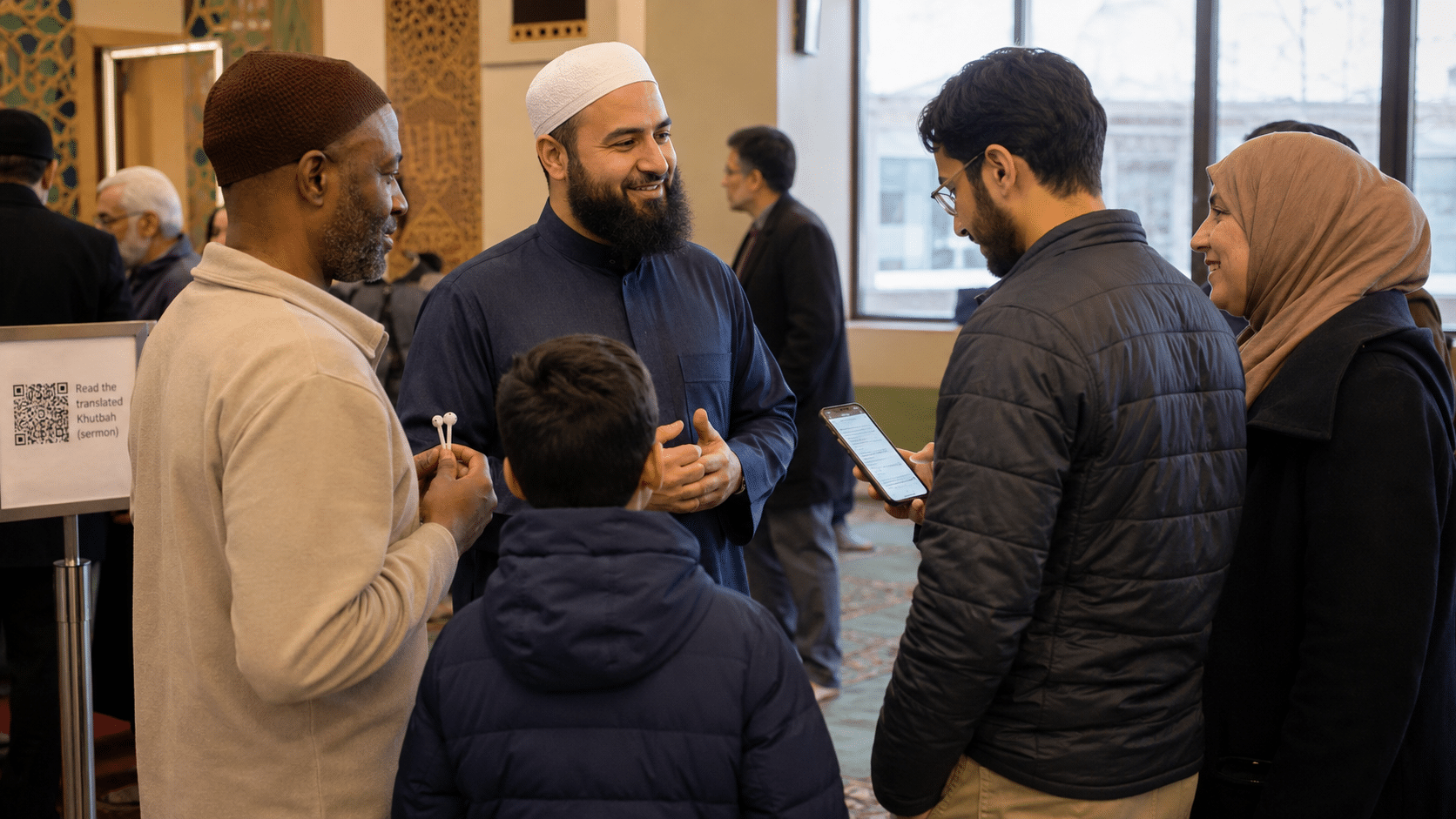
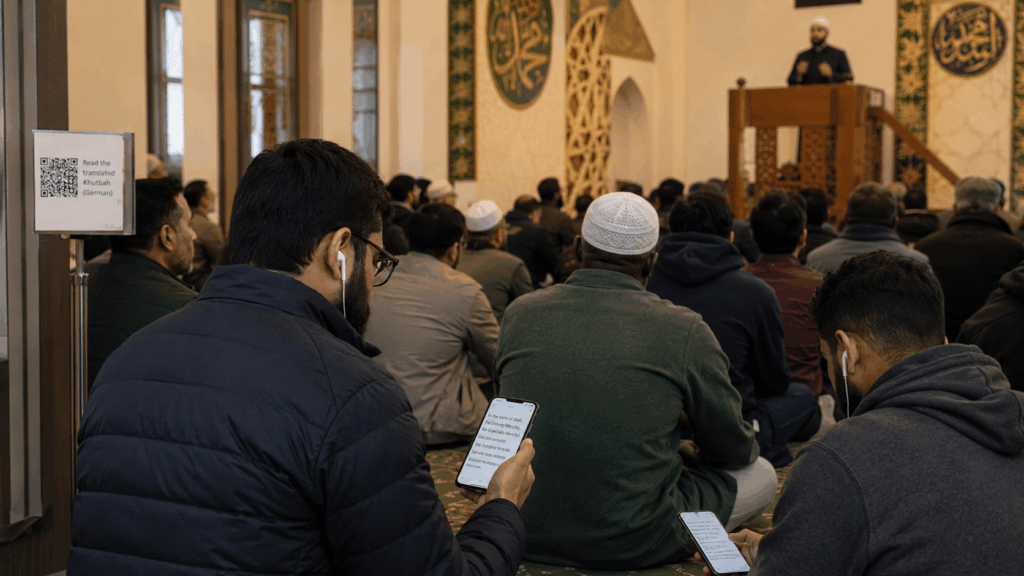
A person comes to Jumu’ah. At the entrance or on a screen, they see a QR code. They scan it with their phone, choose their language, and follow the live translation of the khutbah.
No need to install an app. No additional equipment. No special registration. Just open the link and follow the content.
For the imam, nothing essential changes. He speaks as usual. But for the person who does not understand the language of the khutbah, a lot changes.
Suddenly they are no longer only physically present. Now they are included. They understand the topic. They can follow the message. They can talk about it later with their family. They can feel like part of the community.
That is a special value of digital tools in a jamaat: they must not complicate worship and organization; they should remove barriers.
Multilingualism is no longer a luxury—it’s a necessity
Many Islamic organizations today operate in a multilingual environment.
In some jamaats this is a consequence of migration. In others it is the result of the second or third generation of Muslims in Europe. In some cases it is students, travelers, or workers. In others, it is new Muslims who come from completely different cultural backgrounds.
That is why the language question is no longer a side issue.
If an organization wants to be open, inclusive, and beneficial to the wider community, it must think about how different groups of people can understand its content.
This does not mean abandoning the jamaat’s original language. On the contrary, the original language remains an important part of identity. But alongside it, it is possible to offer additional translations, subtitles, transcripts, and summaries.
In this way, the organization preserves its identity while also opening the door to others.
Video content: the jamaat’s great untapped potential

Many jamaats already record lectures and publish them on YouTube, Facebook, or other platforms.
But it often happens that a video is published without additional processing. The title is short. The description is almost empty. There is no transcript. No subtitles. No translation. No SEO structure. After a few days, the video disappears into the sea of other posts.
That is a shame, because one high-quality lecture can have long-term value.
If a video is automatically converted into text, gets subtitles, translations, an SEO title, a description, and a dedicated public page, then that content becomes much more useful.
Then people searching Google can find it. People who can’t listen to audio can watch it. People who don’t understand the original language can follow it. The organization can share it again. It can extract quotes, shorter clips, social media posts, or educational material from it.
In other words, one video is no longer just a video. It becomes a complete digital resource.
Islamic centers are not only a place for Jumu’ah
When we talk about a digital jamaat, we’re not talking only about the Friday khutbah.
Many Islamic centers today have a much broader program: regular lectures, seminars, panels, youth gatherings, women’s education, maktab classes, conferences, Ramadan programs, guest speakers, and special events throughout the year.
In such programs, a lot of valuable content is often delivered.
Some talks last 20 minutes, some an hour, and some conferences have multiple speakers and several hours of material. But if that content is not recorded, processed, and preserved, its benefit mostly remains limited to those who were present that day.
That is a great loss.
Because one high-quality lecture can help a student looking for an answer to a specific question. It can benefit a parent who wants to talk with children about a topic. It can help a new Muslim better understand basic concepts. It can remain valuable material for future generations.
That is why Islamic centers should think of every lecture and event as content that can continue to live after the program ends.
Podcast Live: when a lecture becomes a lasting audio and text resource

One way Islamic organizations can make better use of their content is through the podcast format.
A podcast doesn’t have to mean only a professional studio, expensive equipment, and specially recorded shows. In the context of a jamaat, a podcast can also be a recorded lecture, lesson, conversation, khutbah, or panel that is later turned into audio content, a transcript, and multilingual material.
This is where the Podcast Live module especially stands out.
Let’s imagine that an Islamic center organizes a lecture after Maghrib. The speaker talks about family, raising children, youth challenges, or another important topic. People who are present can listen live, but at the same time the content can be recorded, transcribed, and prepared for later publication.
After that, the organization can get:
- a textual transcript of the lecture,
- a summary of the main messages,
- translation into other languages,
- a description for the website,
- material for a newsletter,
- a basis for shorter social media posts,
- audio or video content that can be shared with community members.
This means one lecture does not remain a one-time event.
It becomes a lasting resource.
For the organization, this is a big advantage, because the effort of the speaker and organizers is preserved better. For members of the jamaat, it means they can return to the content later. For those who couldn’t attend, it means they can still benefit.
Studio module: from one video to a multilingual educational page
Video is one of the most important forms of communication today.
People often prefer to watch a video rather than read a long text. But a video without subtitles, translation, and a good description has limited reach.
The Studio module helps solve this problem.
An organization can upload its own video or import a video already published on platforms like YouTube, Facebook, or other sources. After that, the system can help create subtitles, a transcript, translations, and SEO elements.
This means a single video can become accessible to people who speak different languages.
For example, a lecture delivered in Bosnian or Croatian can get subtitles in German, Arabic, Turkish, Albanian, English, French, or other languages. That way, the content is no longer limited only to those who understand the original language.
The Studio module is especially useful for Islamic centers in the diaspora, where one organization often brings together people of different backgrounds and different language habits.
One video can be useful to older community members, youth, new Muslims, students, parents, and people living outside the local jamaat.
And when the video gets its own public page with a title, description, transcript, and translations, it becomes much more visible and useful.
Conferences and larger events: a big opportunity for long-term visibility
Conferences and larger Islamic events have especially great potential.
Many Islamic centers invest great effort in organizing conferences. They invite guest speakers, prepare the program, gather an audience, record the event, and often invest significant resources in equipment, space, and promotion.
But after the conference ends, the content is often published only as a long recording on social media.
Such a recording can be useful, but it is not used optimally.
With a good digital process, one conference can be turned into a whole library of content:
- each lecture can have its own separate video,
- each video can have subtitles,
- each lecture can have a transcript,
- the most important messages can be extracted as short clips,
- content can be translated into multiple languages,
- each topic can get an SEO description,
- the organization can have an archive of the conference on its website,
- the material can be shared for months after the event.
That way, the conference doesn’t last only one day.
Its benefit continues to spread over time.
This is especially important for Islamic centers that want to be recognized as serious educational centers, not just a local gathering place.
Guest speakers and an international audience
Many Islamic centers occasionally bring in guest speakers from other cities or countries.
This is a great value for the community, but there is often a language barrier.
The speaker may speak Arabic, Turkish, Bosnian, English, or another language. Part of the audience understands, part doesn’t understand enough, and part could benefit if the content were translated.
By using live translation, subtitles, and a later multilingual transcript, the organization can make the guest lecture available to a much wider audience.
This also opens a new possibility: an Islamic center can share quality content with other communities.
If one center organizes an exceptionally beneficial lecture, another center can later recommend it to its members, with a translation into the language that community needs most.
In this way, Islamic knowledge and beneficial messages can spread in a more organized, responsible, and accessible manner.
SEO for Islamic organizations: why does it matter?
SEO often sounds like a technical or marketing term that has little to do with jamaats.
But in reality, SEO means a very simple thing:
Will people be able to find beneficial Islamic content when they are looking for it?
If someone searches for “how to understand a khutbah in German,” “Islamic lecture on family,” “khutba translation,” “khutbah translation,” “Islamic center near me,” or similar terms, the question is whether they will come across quality content from your organization.
If a jamaat has only a video without a description, without text, and without translations, the chances are lower.
But if every video, khutbah, or lecture has a good title, description, transcript, translation, and a public page, then the organization becomes more visible.
This does not mean turning religious content into marketing. It means organizing a valuable message better so it can reach those who can benefit from it.
Digital archive: preserving the community’s knowledge
One of the biggest advantages of digital tools is the ability to archive.
How many khutbahs, lessons, and lectures have been delivered in our jamaats, only to not be preserved anywhere afterward?
How many beneficial messages were said, but heard only by those who were present that day?
A digital archive makes it possible to change that.
Every khutbah can be saved. Every lecture can have text. Every video can have subtitles. Every topic can be searchable. Community members can return to content when they need it.
This also has great value for imams and organizations. They can more easily track which topics have already been covered, prepare new lecture series, share older content at the right moment, and build a long-term library of knowledge.
In this way, a jamaat does not build only a program for one week, but a lasting educational space.
From events to the Islamic center’s digital library
In the long run, every Islamic center can build its own digital library.
That library can include khutbahs, lessons, lectures, conferences, youth programs, Ramadan series, thematic panels, and educational video materials.
But the difference between an ordinary archive and a true digital library is structure.
An ordinary archive is just a collection of old recordings.
A real digital library has titles, descriptions, transcripts, languages, categories, searchability, and a clear way to access it.
When content is organized like that, it becomes much more useful.
A member of the jamaat can find a lecture about marriage. A parent can find a topic on raising children. Young people can find content about identity. A new Muslim can find basic explanations. An imam can more easily recommend specific material to someone with a concrete question.
MinbarLive can help precisely in that direction: to turn the content an organization already produces into a structured, accessible, and multilingual library.
How does MinbarLive help create a digital jamaat?
MinbarLive was developed precisely from the need to make this process easier for Islamic organizations.
The goal is not for organizations to have to hire technical teams, translators, editors, and SEO specialists just to make their content accessible.
The goal is for technology to take over as much of the technical work as possible, while the imam and the organization remain focused on what matters most: the message, the community, and the people.
MinbarLive can help across several key areas:
Live translation of khutbahs and events
Congregants can follow a speech live in a language they understand, simply via a link or QR code.
Automatic transcripts
Khutbahs, lectures, conferences, and conversations can be automatically turned into text that can later be edited, stored, and shared.
Multilingual translations
Content can become available in a large number of languages, which is especially important for the diaspora and multicultural communities.
Podcast Live module
Lectures, lessons, and conversations can be turned into audio, a transcript, a summary, and multilingual material that the organization can use even after the event.
Video Studio module
An organization can upload or import a video and automatically get subtitles, a transcript, translations, and SEO data.
Public pages for content
A video, lecture, or conference material can get its own public page, accessible to community members and search engines.
Publishing on an organization and shared domain
Content can be available on the organization’s website, but also through the broader MinbarLive public domain, which further increases visibility.
Ability to use beneficial content from other organizations
If one organization publishes a high-quality video or lecture, another can more easily make it available to its members through a multilingual approach.
Digitalization doesn’t have to be complicated
One common obstacle is the feeling that digital transformation is too big of a task.
Many organizations think they must immediately have a perfect website, a professional studio, a social media team, translators, and a video editor.
But that isn’t necessary.
It is enough to start with a few simple steps:
First, make it possible to record and archive khutbahs or lectures.
Second, add a transcript so the content doesn’t remain only in audio or video form.
Third, provide translation for the languages that matter in the local community.
Fourth, publish content in a structured way, with clear titles and descriptions.
Fifth, regularly share beneficial materials with jamaat members.
It doesn’t have to be perfect from day one. What matters is that the organization starts.
A special benefit for younger generations
Young Muslims often live between multiple languages and multiple identities.
At home they may hear one language. At school, university, or work they use another. Online they most often consume content in a third language—most often English or the language of the country they live in.
If religious content is offered only in a language young people understand less well, there is a risk they gradually drift away—not because faith doesn’t interest them, but because the content isn’t accessible enough.
Multilingual subtitles, translations, short video clips, and a digital archive can help strengthen the bridge between generations.
Young people can listen to the khutbah in their parents’ language, while following a translation in a language they understand better. They can share the video later. They can find a topic that interests them. They can connect with the message more easily.
That is a big deal.
A special benefit for new Muslims
New Muslims often have a strong desire to learn, but they may feel lost if they do not understand the community’s language.
The mosque may be dear to them, but at the same time somewhat unfamiliar. People around them may already know how to behave, what is learned when, where things are, and whom to approach. A new Muslim is only discovering all of that.
If the khutbah, lecture, or basic explanations can be followed in a language that person understands, that first contact with the community can be much easier.
This does not mean a digital translation will replace a conversation with the imam, a teacher, or jamaat members. On the contrary, it can be a first bridge that helps a person feel encouraged, understand the basic message, and take the next step: ask a question, attend a lecture, meet people, and become part of the community.
Technology here does not take on the role of religious authority. It only helps open the doors of the community wider.
Technology does not replace the imam and scholars
With every digitalization of religious content, it is important to be careful.
Islam is not just information. Islam is transmitted through knowledge, adab, understanding, experience, learning from trustworthy people, and living in community.
That is why digital tools must not create the impression that an app, a translation, or an automatic transcript can replace the imam, a scholar, a teacher, or direct conversation.
Especially with sensitive religious questions, people should not rely only on automatically translated text or generated content. Such tools can help with understanding, but they cannot replace expert interpretation, context, and the responsibility of those who have knowledge.
In that sense, MinbarLive should be understood as an auxiliary tool.
It can help the khutbah be heard better, make a lecture easier to understand, make a video accessible in multiple languages, and preserve content more effectively. But religious authority, direction, and responsibility remain where they should be: with the imam, knowledgeable people, and the organization itself.
That is an important boundary.
Digitalization is beneficial only if it serves knowledge, community, and people—not if it tries to replace them.
The true heart of the jamaat remains in real encounters
A jamaat is not just a group of people receiving information.
A jamaat is an encounter. Salam. Rows in prayer. A glance. A helping hand. Conversation after prayer. A child coming to maktab. An elderly member someone helps. A family that feels accepted. A new Muslim who finds support. A young person who receives advice at the right moment.
That cannot be digitized.
No app can replace the warmth of a real jamaat.
But good technology can help more people reach that real encounter.
If someone first finds a video lecture in their language, they may feel encouraged to come to the mosque. If someone follows the live translation of a khutbah, they may feel more included. If someone can’t attend a lecture, they can watch it later and stay connected. If a parent wants to share a khutbah with children, they can send them a link with a translation they understand.
A digital tool then does not distance people from the mosque. On the contrary, it can bring them closer.
The jamaat as a source of reliable content
Today people increasingly look for answers online.
This can be beneficial, but it can also be dangerous. The internet is full of content of varying quality. Some texts are good, some superficial, some inaccurate, and some may be completely wrong or harmful.
That is why Islamic organizations have an important opportunity: to become a recognizable source of reliable, locally relevant, and responsibly prepared content.
If a jamaat regularly publishes khutbahs, lectures, explanations, and educational video materials, then community members have a place they can return to.
This is especially important for parents, youth, new Muslims, and people who want to learn but don’t know where to start.
Instead of everyone wandering the internet on their own, the jamaat can offer structured, verified, and understandable content.
And when that content is available in multiple languages, its benefit spreads even further.
How one piece of content can live in multiple ways
One khutbah or one lecture doesn’t have to remain only one event.
For example, an imam delivers a khutbah on Friday. After that, it can produce:
- a transcript of the khutbah,
- translations into multiple languages,
- a summary for jamaat members,
- a short quote for social media,
- a video with subtitles,
- an audio recording,
- an SEO description for the website,
- an archive page people can find later.
In this way, one effort gains multiple value.
The imam doesn’t have to create new content from scratch every time for each channel. The organization can make better use of existing content, edit it, and share it.
This is especially important for smaller jamaats that don’t have large teams.
Digital tools can help achieve better content organization with less manual work.
An example of a practical workflow for one organization
An Islamic organization can start very simply.
First, during the khutbah or lecture, it uses MinbarLive for live transcription and translation.
Congregants who don’t understand the original language can follow the live translation via a QR code.
After it ends, the organization gets a text record. This record can be reviewed, edited, and saved.
If there is a video recording, it can be added to the Video Studio module. The system can help create subtitles, translations, a title, a description, and a public page.
If it is a lecture, panel, or conversation, the content can also be prepared through the Podcast Live approach: as audio, a transcript, a summary, and multilingual material.
Then the content can be published on the organization’s website, shared in a WhatsApp group, sent to members via a newsletter, or posted on social media.
That way, one event in the mosque becomes available even to those who could not be present.
But everything starts from the real jamaat, the real khutbah, the real lecture, and the real work of the organization.
The importance of control and editing of content
With automatic transcripts and translations, there should always be room for human review.
AI can significantly speed up the process. It can recognize speech, translate text, and suggest a title, summary, and SEO description. But with religious content, it is especially important that the organization has the ability to review and edit.
Some expressions have specific meanings. Some ayat, hadith, or religious terms must not be translated superficially. Some sentences depend on context.
That is why the best approach is not “publish automatically and forget.”
A better approach is: let technology handle the first technical layer, and then let a responsible person review the content, correct what is needed, and publish it with confidence.
That is how the speed of technology and the organization’s responsibility come together.
Digital presence as hizmet
When used correctly, a digital presence can be a form of hizmet.
It’s not just “online marketing.” It is a way to make it easier for people to access beneficial knowledge.
A mother who cannot come to a lecture because she’s caring for children can watch the recording later.
A worker who works on Fridays can read a khutbah summary.
A young man who understands German or English better can follow the message in a language closer to him.
A new Muslim can gain basic understanding without feeling completely lost.
An elderly person can get a link that a family member plays at home.
A jamaat member who moved to another city can still remain connected to their community.
These are concrete human benefits.
And that is why digitalization makes sense only if it leads to greater closeness, better understanding, and a stronger community.
The most common obstacles in digitizing a jamaat
Many organizations don’t start digitalization because they think it is too complicated.
Some don’t have a technical person. Some don’t have time. Some don’t know where to start. Some fear that digital tools will undermine the traditional character of the jamaat.
These are understandable concerns.
But digitalization doesn’t have to mean a big project.
You don’t have to change everything at once.
It is enough to start with one useful step.
For example:
- enable live translation for the khutbah,
- start archiving khutbahs,
- add subtitles to the most important video recordings,
- translate key lectures into the languages of community members,
- create a public page with the most important content,
- regularly send useful links to jamaat members.
Small steps, if done consistently, can bring a big change.
How do you measure the success of a digital jamaat?
Success doesn’t have to be measured only by the number of views.
Of course, it is useful to know how many people opened a video, how many followed a translation, or how many times a page was visited.
But for a jamaat, deeper questions matter too.
Did people understand the khutbah better?
Did foreign community members feel more included?
Did young people share the content more?
Did new Muslims find basic information more easily?
Did members who can’t attend regularly stay connected?
Did the imam get a better way to preserve and organize his work?
Did the organization become more visible and accessible?
Did lectures, conferences, and guest programs gain long-term value?
Those are the real measures of success.
Technology is not the goal. The goal is better connection, understanding, and benefit.
The future of Islamic organizations will be hybrid
In the future, the most successful organizations will likely be those that combine two worlds well.
On the one hand, they will preserve a living community, presence in the mosque, conversation, trust, and the authority of the imam.
On the other hand, they will use digital tools to make content more accessible, more organized, and more visible.
This doesn’t have to be a conflict.
On the contrary, it can be a powerful combination.
The mosque remains the gathering place. The imam remains a guide. The community remains the heart of everything. And digital tools help the message be heard more clearly and farther.
Conclusion: digital tools should serve the jamaat
A digital jamaat is not a replacement for a real jamaat.
It is a jamaat that uses modern tools to better fulfill its mission.
To help people understand the khutbah.
To make lectures accessible.
To connect generations.
To make access easier for new Muslims.
To preserve knowledge.
To increase the visibility of beneficial content.
To save the organization time.
To make the message available to those who do not speak the same language.
Digital tools are especially valuable for Islamic centers that regularly organize lectures, conferences, and educational programs. Each such event requires effort, time, and knowledge. That is why it is a shame for its benefit to end only with those who were present that day. With live translation, transcripts, subtitles, podcast processing, and the Studio module, each event can become a lasting resource for the community.
In this way, MinbarLive doesn’t help only in the moment while the khutbah or lecture is taking place. It helps the organization build a long-term digital library of knowledge, accessible to jamaat members, youth, new Muslims, and everyone looking for reliable and understandable Islamic content.
In a time when people increasingly live between different languages, schedules, and digital habits, Islamic organizations have an opportunity to be present where people are—without losing their essence.
MinbarLive is one of the tools that can help on that path.
Not as a replacement for the imam.
Not as a replacement for the mosque.
Not as a replacement for the community.
But as a bridge.
A bridge between the speaker and the listener.
A bridge between languages.
A bridge between generations.
A bridge between an event that happened today and a person who will find it tomorrow.
And when technology becomes a bridge to greater understanding, then it gains its true value.
CTA
Turn khutbahs, lectures, and conferences into a lasting digital resource
MinbarLive helps Islamic organizations enable live translation, automatic transcripts, multilingual subtitles, podcast processing, and SEO-optimized video pages—so that every event has long-term value.
See how MinbarLive can help your center


